From index replication to outcome engineering:

The next opportunity for ETF liquidity providers

Broadridge Image

Origins: Simplicity and scale

ETFs were born out of investor demand for efficient, low cost and easily tradable access to diversified exposures. Early ETFs tracked broad equity benchmarks, offering passive, rules-based exposure that often outperformed active strategies. Their clarity and transparency fueled explosive growth, supported by an ecosystem of issuers, authorized participants, market makers, exchanges, and index providers—each optimized to support benchmark replication.

Expansion: Fixed income comes on exchange

The ETF model extended naturally into fixed income because it solved bond market inefficiencies. By bringing over-the-counter instruments onto exchange, bond ETFs delivered price transparency and daily liquidity to an opaque market. Fixed income ETFs are now among the fastest growing categories globally. During stress events such as the March 2020 “dash for cash,” they often traded more efficiently than their underlying bonds—cementing their role as core liquidity tools for both retail and institutional investors.

Inflection: From core exposure
to targeted outcomes

With core equity and bond exposures largely in place, investors are demanding tools that tailor or enhance returns. Innovation has accelerated around two themes:

  • Enhanced income ETFs: combining index exposure with options overlays to meet yield demands.
  • Outcome based ETFs: targeting defined ranges of return or protection through structured option strategies.

According to data from the Broadridge Global Demand Model, global active ETF AUM grew from $368 billion in 2021 to a 2025 estimate of $1.364 trillion and in 2027 expected to reach $2.442 trillion underscoring investor appetite for strategies that go beyond index replication. Despite this surge, active ETFs still comprise only 10% of total ETF assets under management (AUM), clearly suggesting significant room for expansion. 

Explosion in product count: Lessons from structured products

The potential scale of outcome-based ETFs becomes clearer when compared with Europe’s structured products markets, especially with Germany’s index linked segment.

Metric ETFs (Europe) Structured Products (Europe) Index-linked Structured Products (Germany)
Number listed 6,500-7,000 listings 
(~2,300 ETFs) ~1,600,000 ~300,000
Asset / Notional €1.5-1.7 trillion ~€400 billion ~€33 billion

Implications: A new liquidity paradigm

As ETFs evolve into packaging investment vehicles combining multiple asset classes, option-like and structured payoffs, the role of market maker fundamentally shifts from delta-based inventory management to full risk intermediation. Rather than providing liquidity based on relatively static risk decomposition onto its constituents and proxies and hedge on the open market, the market maker must:

  • Handle cross-asset underlying risk factors
  • Price non-linear and path-dependent risks
  • Dynamically manage risk by skewing liquidity supply and hedging across multiple markets, CRB and bi-lateral channels
  • Incorporate current liquidity dynamics and counterparty profiles into execution and risk pricing

Opportunity: Engineering the next generation of ETF liquidity

The convergence of ETFs and structured products is creating new opportunities for liquidity providers who can price, hedge, and manage optionality with precision. As ETFs evolve to resemble structured instruments rather than simple index trackers, success will hinge on cross asset expertise and advanced risk intelligence.

The next phase of ETF growth will be defined not by lower fees, but by the sophistication and agility of market makers that can dynamically manage complex, multi-asset exposures. Those that master this convergence will shape the future of ETF liquidity and market efficiency.

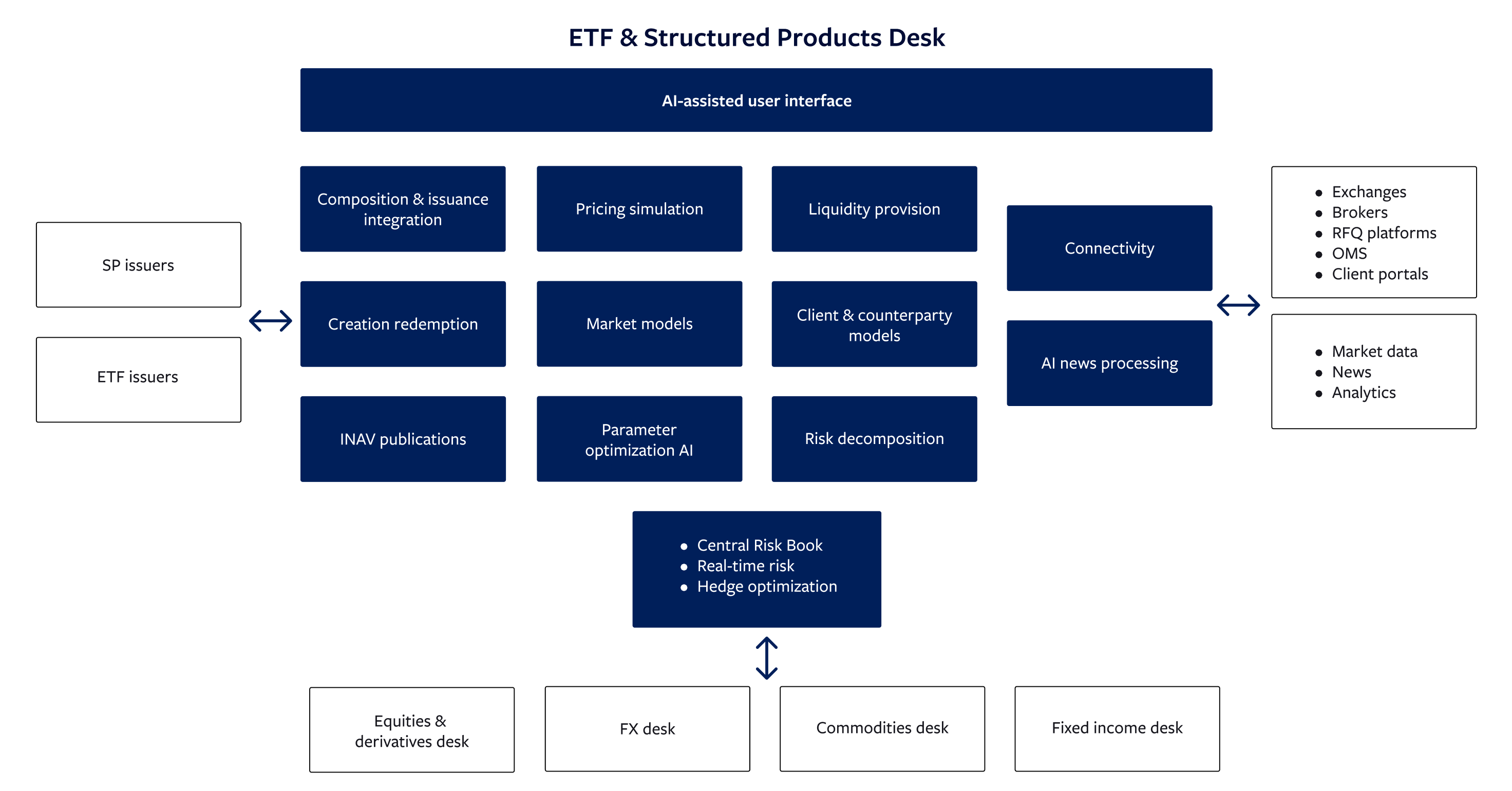
There is now a clear opportunity for market makers to rethink their trading technology:

  • Incorporate pricing and risk models of non-linear, structured and path-dependent payoffs directly in the ETF market making system and via tight real-time integration with automated asset-specific desks.
  • Ensure scalability of the trading system to support explosion in the number of products and dynamic issuance, from performance, usability, risk and compliance standpoints.
  • Leverage CRB, client and bi-lateral flows to optimize liquidity provision and offload risk.
  • Transition from a fixed set of execution algos to dynamic execution strategies, self-adapting to the current market environment and handling regime shifts.

Solution: Tbricks—powering the ETF trading desk of the future

Tbricks powers the ETF trading desk of the future by combining cross-asset expertise, advanced risk intelligence, dynamic hedging, modular agility, and scalable connectivity. This directly addresses the demands of complex, multi-asset, outcome-based ETFs and supports market makers in shaping the next phase of ETF liquidity and market efficiency.

Explore the full capabilities of our integrated platform and request a demo.

Broadridge Image

The platform that makes markets better

Cross-asset integration

TBricks unifies ETF, equity, derivatives, FX, and fixed income trading on one platform, providing a real‑time view of exposures and hedges and enabling faster, more coordinated liquidity provision.

Dynamic hedging that protects margins

As ETFs embed optionality, static hedging is no longer sufficient. TBricks supports continuous, cross‑asset dynamic hedging across asset classes - helping firms tighten spreads, reduce residual risk, and stabilize P&L across market conditions.

Modular agility for faster product launches

A modular architecture allows rapid deployment of new and proprietary pricing, hedging, and execution strategies, helping firms keep pace with issuer innovation and capture early liquidity.

Connectivity and scalability

Open APIs and deep exchange connectivity support thousands of instruments and frequent new launches without sacrificing latency, stability, or control.

What's next for your business?

We want to hear more about what you need to improve your business and drive transformative innovation, efficiency, and growth.

required
required
required
required
required
required
required
required
This site is protected by reCAPTCHA and the Google Privacy Policy and Terms of Service apply.
Want to speak with a specialist?
North America
+1 800 353 0103(option 3)
Australia +61 743 569 934
Hong Kong +852 3004 3094
Singapore +65 31 351 278