The Class Action Case Files
Portfolio monitoring and asset recovery of growing global securities class actions can be daunting. Broadridge can help simplify the complex.
Just the Facts
ViacomCBS (now Paramount Global, NASDAQ: PARA) is a leading American mass media and entertainment conglomerate headquartered in New York City, which became entangled with Archegos Capital Management ("Archegos") in 2021, resulting in significant market disruptions and ultimately a $120 million settlement related to investor losses following an alleged fire-sale of ViacomCBS securities. This $120 million settlement is in line with the trend of “mega-settlements” (settlements worth more than $100 million) and is the largest Section 11 settlement made in a state court to date.
Bill Hwang, a former hedge fund manager and founder of Archegos Capital Management, his personal family office, quietly amassed a huge exposure to ViacomCBS shares without having to make any public disclosures. 1 He did this by using “total return swaps” which are financial contracts in which Archegos paid a fixed fee to prime broker banks, who held the stock in their own names, and in return received all gains and losses on those shares. Because the banks, not Archegos, were the official stockholders, Hwang’s positions remained hidden from public view.
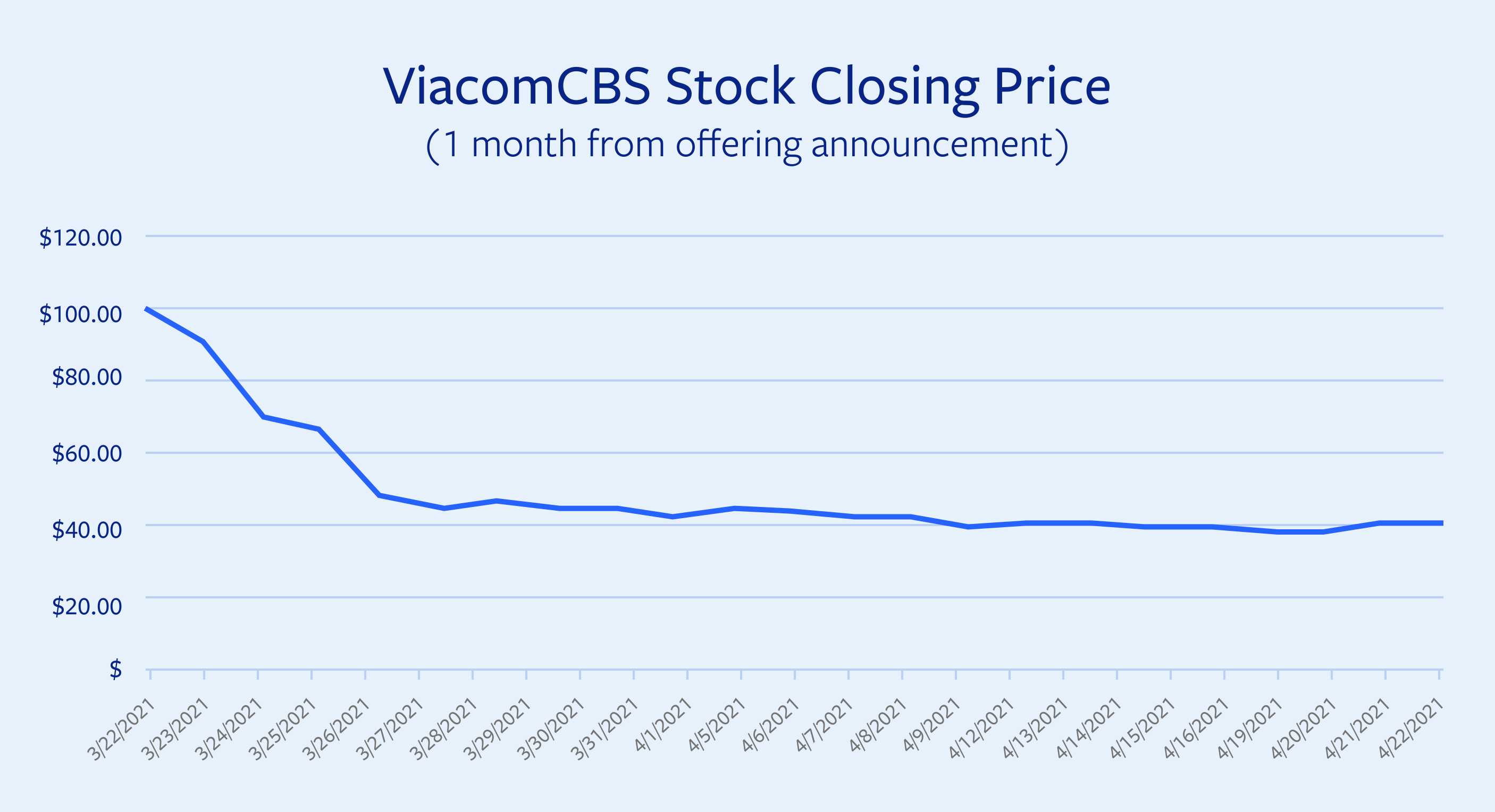
While Viacom’s stocks soared on the momentum of its new streaming service, Paramount+, Archegos ballooned its exposure, eventually controlling roughly $20 billion, or 34%, of Viacom’s equity. In March 2021, Viacom announced a $3 billion public offering of common and preferred shares. This, however, led to a dip in the prices of the Viacom stocks due to an apparent lack of interest in that offering.
Because Archegos’s position was highly reliant on the prices of the stocks owned through total return swaps, Viacom’s decline in value also meant that Archegos would have to pay the prime brokerage banks the differences. When Viacom told its prime brokers that it could not pay, the banks triggered margin calls and started preparing to dump Viacom shares en masse, all the while it was selling the stocks to the public.
The final prospectus for the offering, dated March 23, 2021, made no mention of the imminent forced liquidation. Public investors bought in at $85 per share (common) and $100 per share (preferred), only to see that by the closing date on March 26, the stocks were being traded at $48.23 and $67.50, respectively—a loss of up to 50% in just days.
On August 13, 2021, plaintiffs filed their original class action complaint under Sections 11 and 12(a)(2) of the Securities Act of 1933, alleging that the offering materials were materially false and misleading. Plaintiffs claimed that the underwriters knew, or should have known, that Viacom’s share price was about to collapse due to Archegos’s failure to meet the margin calls and the anticipated market impact of a fire sale. The underwriters, who served dual roles both as public offering facilitators and prime brokers to Archegos, had already positioned themselves to minimize their own losses.
Investors who purchased or acquired Viacom Class B Common Stock in Viacom’s secondary public offering and/or Viacom’s 5.75% Series A Mandatory Convertible Preferred Stock in Viacom’s initial public offering have up until August 22, 2025 to file their claim form to participate in this $120 million mega settlement.
Case Challenges
Last-in, first-out (LIFO)
The majority of securities class actions in the U.S. involve claims under Section 10(b) of the Exchange Act. Calculating estimated losses under the Exchange Act requires aligning sales with purchases throughout the class period. Typically, these calculations involve matching the shares sold during the class period with the earliest shares purchased by the class member, a methodology known as First-in, First-out (FIFO). In contrast, the Last-in, First-out (LIFO) matching methodology involves class members first matching any sales of the security during the class period with the most recent shares acquired during that same class period without offsetting class period sales against holdings from before the class period. LIFO matching is atypical and can introduce complexities in determining the actual last-in and first-out transactions. Furthermore, based on our experience, we have observed inconsistencies in the application of LIFO matching by filers and even claims administrators, underscoring the need for additional diligence in such cases.
Corporate actions
Corporate actions, such as stock splits (including reverse stock splits), CUSIP changes, mergers and acquisitions, and spinoffs, among others, can have a substantial impact on the holders of securities and the claims-filing process. For example, due to the inconsistent nature of transactional records related to shares acquired through mergers, it is necessary to conduct separate reviews to ensure that any shares exchanged in the merger are correctly categorized in accordance with the requirements of the specific case’s plan of allocation. Failure to accurately identify such shares can result in a claim being deemed ineligible or having a reduced value.
Corporate actions – even those occurring outside the class period – can also influence the filing of claims, depending on the data policies of individual custodians, brokerages, or account managers.
Widely held security
The complexity of portfolio monitoring is heightened when dealing with widely held securities due to the extensive searches and subsequent data exports involved. The time necessary for claim preparation and filing escalates significantly, necessitating extensive quality assurance measures to guarantee the accuracy and completeness of the files before they are ready for submission.
Each year billions of dollars are being left on the table. Find the right advocate who can help you maximize recoveries.