Remember when E*TRADE launched and everyone predicted that young investors – at the time members of Gen X – would forever eschew financial advisors in favor of do-it-yourself online brokerage accounts? A similar phenomenon followed the launch of the first robo-advisors, when futurists thought Millennials would eventually find full-service advice unnecessary.
Now, of course, we’re seeing it in the era of AI and gamified investing apps. But for all that transformation technology has brought to investing, it has yet to change one core set of fundamentals: As young people age, grow their families, acquire more assets and accumulate a more complex set of financial needs, they invariably turn to professional financial advisors.
What has changed over the past decade, however, has been the binary nature of self-directed versus advised investing. Whereas the typical investor journey used to be an evolutionary process through which DIY investors eventually graduated to full-service, today’s marketplace is much less absolute. Investors across age and wealth demographics are juggling self-service and advised accounts and the tipping point at which most investors start taking a serious look at getting professional help is now starting when investors are in their mid-30s.
How are investor preferences for advice evolving and what does that mean for the future of full-service investing? The Broadridge Investor Pulse Series offers a by-the-numbers analysis of the current state of investing based on data drawn from the holdings of over 55 million investors, complemented by semi-annual surveys of 1,000 retail investors and 400 financial advisors.
Hybrid investing becomes a bigger factor
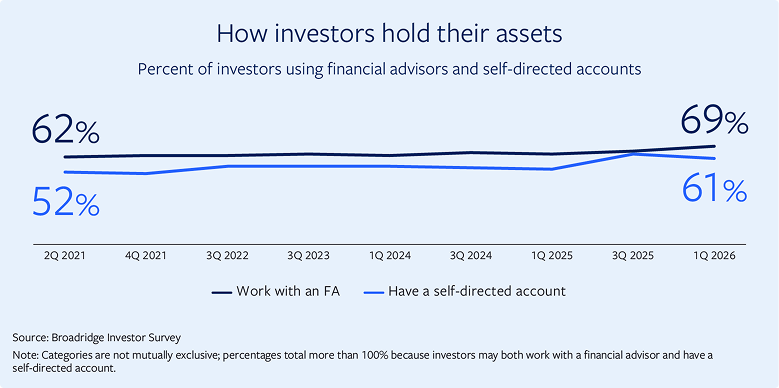
In order to fully understand the current dynamics of the advised channel, we’ve been analyzing investor behavior across a variety of different metrics. The first, and most obvious, is survey-based, through our annual Investor Survey, which runs continuously across several waves throughout the year. The latest survey data, updated through April 2026, shows the growth of a hybrid approach to advice, where investors are combining professional advice with self-directed investing, rather than choosing one or the other. In fact, the total pool of investors working with advisors has grown seven percentage points to 69% over the past five years, while the number of self-directed investors has grown nine percentage points to 61% over the same time period.
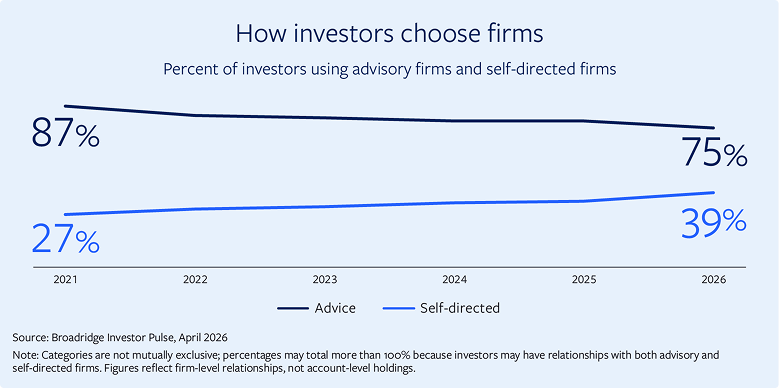
Digging deeper into this phenomenon with our Investor Pulse real-world data, we see that 39% of investors currently maintain a relationship with a self-directed firm, which is up 12 percentage points from five years ago. As a result, some 13% of investors now have relationships with both advisory and self-directed firms. Here again, our data illustrates that there is a great deal of nuance in investor behavior when it comes to advice, and decisions are less about either-or scenarios and more about finding the sweet spot that works for each individual investor.
Shift to advised channel starts at age 35
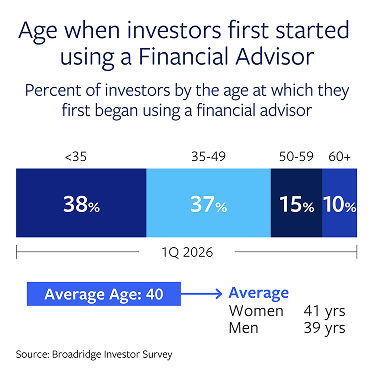
Looking back at our survey data, we find that, on average, investors first start working with an advisor at age 40. That number skews slightly younger (39) for men, and older (41) for women, as indicated in the chart here.
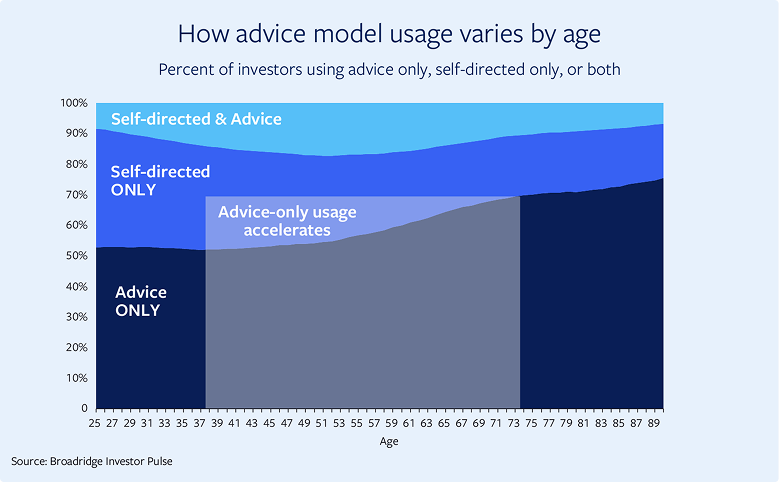
While that dataset is instructive, it is subject to the typical limitations of survey-based research. We’ve also been able to track real-world investor behavior through our Investor Pulse dataset. This snapshot gives us a more granular view of how patterns of self-directed and advised relationships evolve over time, and, as the charts below indicate, shows us that investors typically start to turn to advised channels a little younger than what’s appearing in the survey data. Specifically, the critical mass in interest in advice-only usage starts to build at around 35 years old.
What the real-world investor behavior shows us is that the evolution toward advice-only is continuing, and in fact tilting even younger than survey data would suggest, among Millennial investors. This is a critical insight for financial firms as they guide their marketing efforts to investors at key points in their journeys.
More ‘experts’ and more access than ever
Technology, of course, continues to play a role in this evolution, with many investors drawing investing insight, inspiration, and intelligence from a wide variety of different resources – some of them human, some electronic.
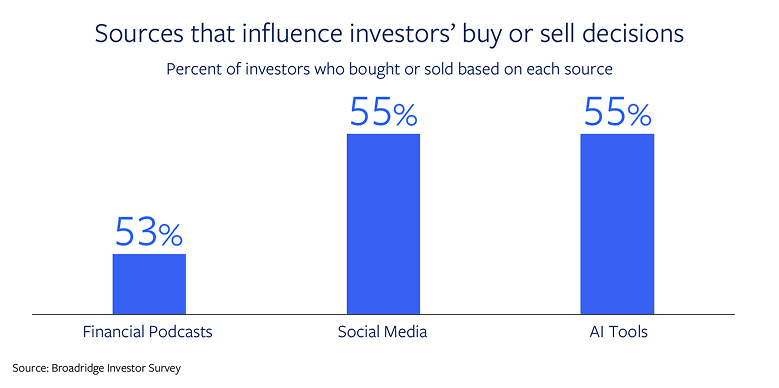
Accordingly, a majority of investors now believe access to investing has improved over the past five years, driven by technology, lower costs, and greater availability of information and products. Many, particularly young investors, are incorporating information from AI, digital tools, podcasts, and social media into their investment decision-making process. As the chart below from our Investor Survey indicates, the majority of investors say they’ve made investment decisions based on information they’ve received from financial podcasts, social media, and AI tools.
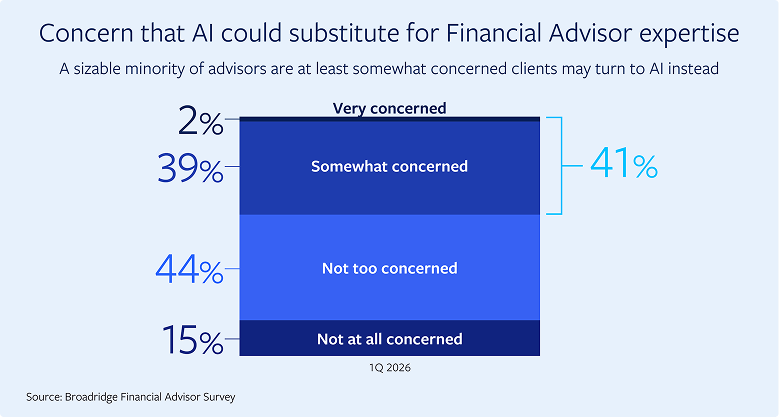
This is a relatively new phenomenon for advisors, who’ve always had to deal with clients discussing tips they’ve heard from friends and family, but are now confronting clients coming in with full-fledged algorithmic strategies developed with the help of ChatGPT and Claude. Some advisors see this as a threat, while others are embracing the opportunity to connect more deeply with clients. According to our Financial Advisor Survey, 41% of advisors say they are concerned that clients will perceive AI-generated advice as a potential substitute for their expertise.
Taken together, the full range of datapoints we’re seeing around investor behaviors and attitudes toward full-service advisory relationships suggest an evolutionary rather than revolutionary change in the way clients and advisors will work together in the future. For everything that has changed – the growth of AI-supported research, the immediate access to no-fee trading across a wide range of asset classes, the always-on nature of markets – many fundamental tenets of investing have not changed. Investors still face challenges that grow increasingly complex as they go through life, and they are still looking for experts to help guide them, even if that expertise is accompanied by a lot more technology-enabled support.
Find out more
This Investor Pulse brief is based on data and insights from the Broadridge Investor Pulse, the Broadridge Retail Investor Survey, and the Broadridge Financial Advisor Survey. It was authored by Andrew Guillette, Vice President, Global Insights, Broadridge. Please contact us at the numbers below to connect with Andrew or to learn more about the underlying research.