In today’s fluid regulatory environment, a functionally rich, robust, and scalable trading and connectivity solution that sell-side firms can rely on to perform key front- and middle-office functions is essential to remain competitive within both regional and global markets. This is particularly true for sell-side firms with large footprints in multiple asset classes (equities, futures, options, and fixed income) looking to navigate shifting compliance and risk obligations across businesses. This white paper examines the state of play for order management systems (OMSs) and the key functionalities these systems must bring to the table in order to drive top lines and manage bottom lines.
Key Findings
Global sell-side firms are beset by significant challenges both regionally and across asset classes
The most often-cited challenge facing sell-side firms with global footprints are regulatory changes and pressures, keeping up with globalization, the current regulatory environment, and further market fragmentation.
Customer needs are growing, and the sell-side is responding through front-office innovation
Decision-makers at sell-side firms cite assistance with global connectivity, regulatory compliance, robust reporting capabilities, and workflow automation solutions as key customer needs in 2023. In turn, sell-side firms cite building out a robust compliance and reporting functionality, workflow automation technology, and global connectivity solutions as key focus areas of front-office innovation.
Brokers report three key metrics for judging trade optimization success
Institutional brokers report three key factors for evaluating the success of bank trading optimization initiatives across all sell-side firms. In order of priority, those priorities are risk reduction, increased scalability, and an increase in revenue.
Introduction
Regardless of asset class or regional trading nuance, global banks of all stripes are staring down a technological fork in the road with respect to front-office innovation. Legacy vendor solutions and in-house-built tools require significant resources each year to simply maintain the technology status quo. Sell-side firms wanting to stay ahead of the curve will need to reevaluate the value proposition of their existing OMS architecture and determine if the solutions they have in place today merit the ongoing cost.
After all, the list and breadth of OMSs sell-side firms once had to choose from was, until recently, limited. This is particularly true with respect to multi-asset-class OMS solutions for futures and options. This lack of vendor optionality has been a principal driver behind a preference among the largest banks to design and implement a customized OMS in-house.
The landscape has evolved, and sell-side OMS vendors today are bringing to market modular, globally focused tools that can adapt and simplify increasingly complex workflows across the spectrum of key front-office functions (high touch, low touch, and portfolio trading) along with compliance, middle-office, and connectivity services within one OMS ecosystem—essentially providing building blocks for firms to build custom solutions tailored to their regional and asset class needs (without having to truly start from scratch).
This white paper examines the current state of play that global OMSs sell-side firms rely on to maintain a trading edge within an increasingly competitive global market. In particular, this paper focuses on regional nuances and commonalities across U.S., EU, and Asia-Pacific markets in terms of the challenges sell-side firms face regarding existing front-office technology, customer demands, key initiatives to satisfy these customer requirements, and key metrics for measuring success in front-office innovation.
Methodology
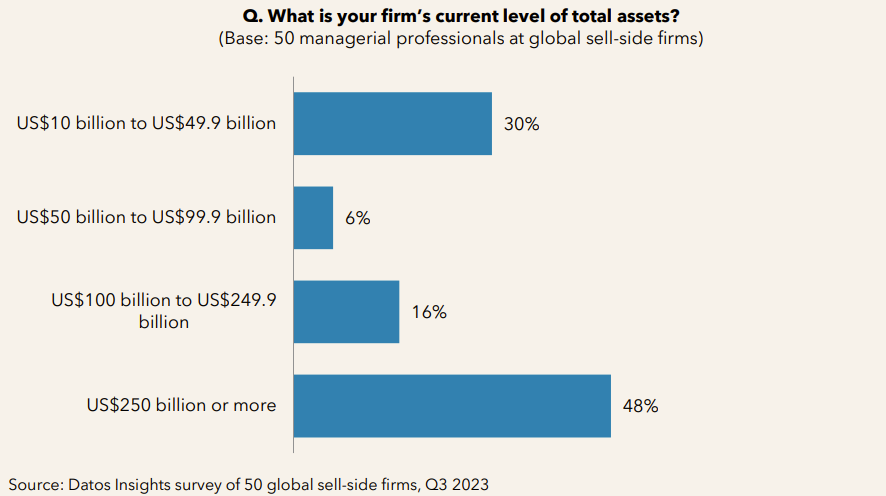
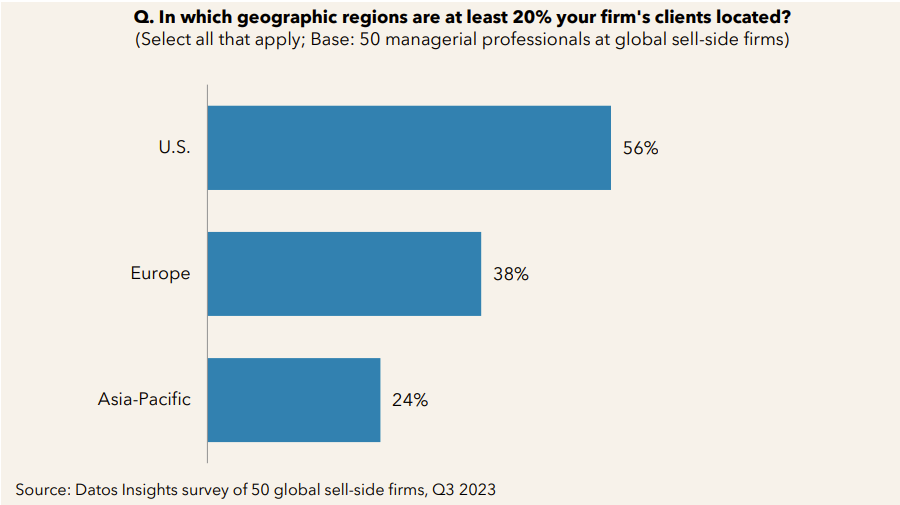
This report leverages results from a Datos Insights survey targeting 50 senior technology executives and trading decision-makers at sell-side institutions with global footprints (in U.S., EU, and Asia-Pacific markets) during Q3 2023. In addition to the survey results—the demographics of which are broken down in Figure 1 and Figure 2—Datos Insights also conducted several qualitative interviews with senior executives at global banks to gain perspective on key challenges and themes driving decision-making today.