Is the ‘Robinhood Generation’ Getting Bored with Index Funds and ETFs?

The S&P 500 returned a whopping 18% in 2025 and leading strategists’ projections for 2026 are calling for another double-digit year in the range of 10-13%. That is nearly two times the inflation-adjusted long-term historical average of around 7% for the typical index-tracking mutual fund or ETF. With these kinds of returns, conventional wisdom would suggest that low-cost, passive investments that track the major indices are pretty hard to beat.

But not all investors agree that passive strategies are the best approach in the current market. Younger investors in particular – those who’ve been weaned on gamified investing apps, an explosion of new asset classes, and the innate belief that they can outsmart the markets – are driving a nascent trend toward more actively managed strategies.

How will these trends affect the future of active and passive fund management strategy, and how are advisors positioning themselves to manage this evolution? The Broadridge Investor Pulse Series offers a by-the-numbers analysis of the key emerging trends driving investor behavior based on data drawn from the holdings of over 50 million investors, complemented by semi-annual surveys of 1,000 retail investors and 400 financial advisors. Each Investor Pulse Brief offers a focused look at investor behaviors and market trends.
The rise of the passive ETF

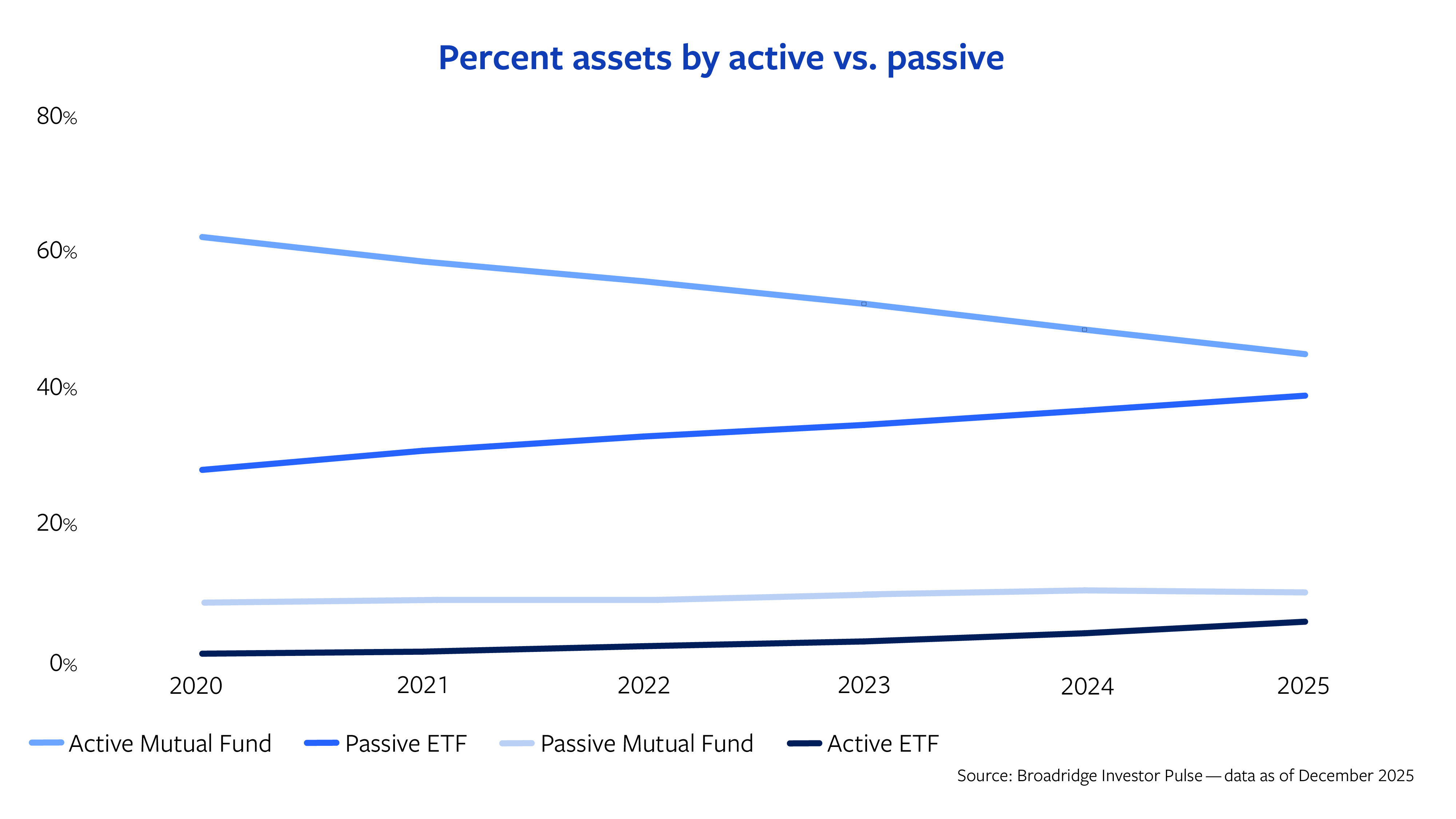
Passive investment strategies, led by ETFs, have been gaining in popularity for the better part of the last decade. According to the Broadridge Investor Pulse, 39.0% of U.S. investors’ assets are now held in passive ETFs, up from just 28.1% in 2020, while 10.1% of assets are held in passive mutual funds, up from 8.6% in 2020. Meanwhile, the share of assets held in actively managed mutual funds has trended down to 45.1% from 62.3% over that same period.

Active ETFs, however, have moved in the opposite direction, steadily gaining assets for the past five years. Currently, active ETFs account for 5.8% of total assets, up significantly from 1.1% since 2020.

Placeholder

Looking at these numbers against the recent performance of the major indices, most analysts have focused on the rapid growth of passive ETFs as a signal that the reign of the actively managed mutual fund as the preferred investment vehicle of everyday investors is coming to an end. That logic does not address the complete story, however. A subtle and more nuanced trend is developing in the world of actively managed ETFs and other investment solutions which could signal a generational shift in investment styles taking shape.

I think I can do better

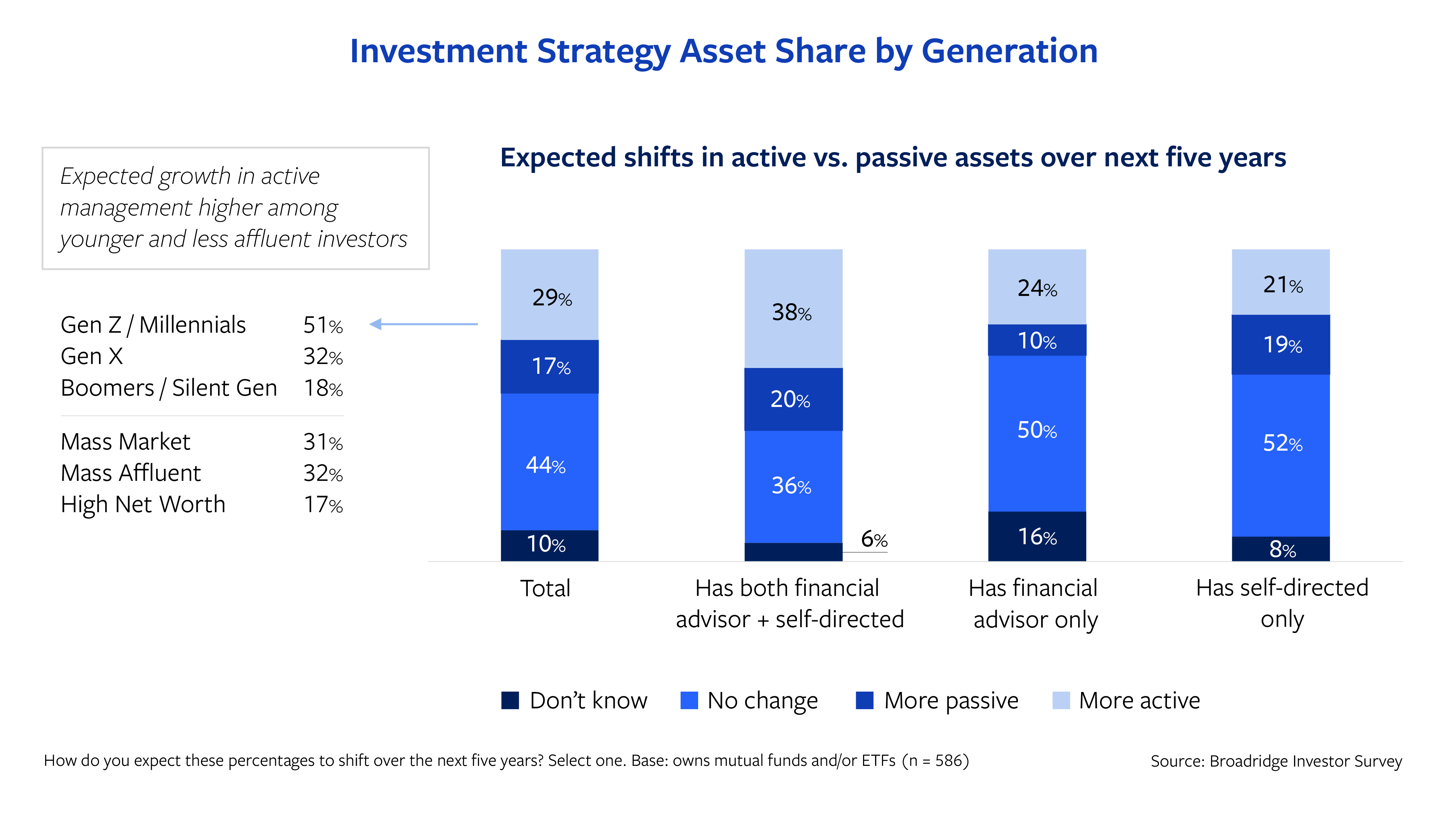
Specifically, younger investors who have come of age in an era of hyperconnected, digital communications, no-fee trading, and rapid asset class expansion are showing more interest in active strategies. According to the Broadridge 2025 Investor Survey, 29% of investors say they plan to shift more of their assets into active strategies over the next five years. Among members of the Millennial and Gen Z generations, that number jumps to 51%. That’s a significant shift, especially when you consider this group is also on the cusp of inheriting more than $100 trillion over the next two decades.

Placeholder

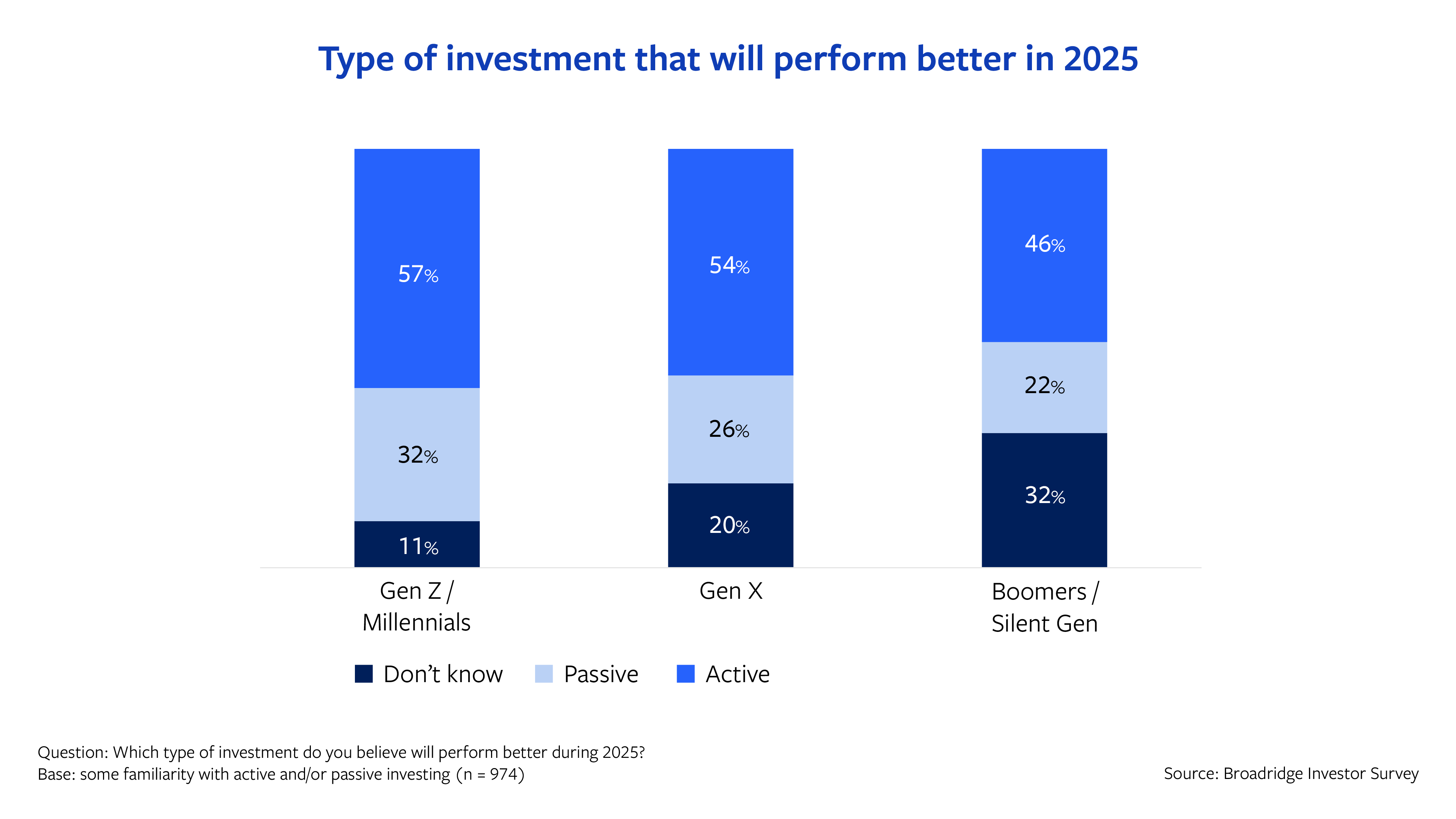
This positive sentiment toward active strategies appears to be driven by a belief among investors that active strategies will perform better over the near-term. Overall, 51% of investors say they feel active strategies will perform best over a one-year timeframe. Among Millennial and GenZ investors, that number jumps up to 57%. That means, more than half of all investors, whether advised or self-directed, expect to outperform the S&P 500. This belief is even more common among younger investors, further fueling support for active management.

Placeholder

Not your grandparents' active strategy

While the surge in interest among young investors in active strategies is noteworthy, there is currently a gap between what young investors believe about future performance and how they behave today when it comes to their actual investments.

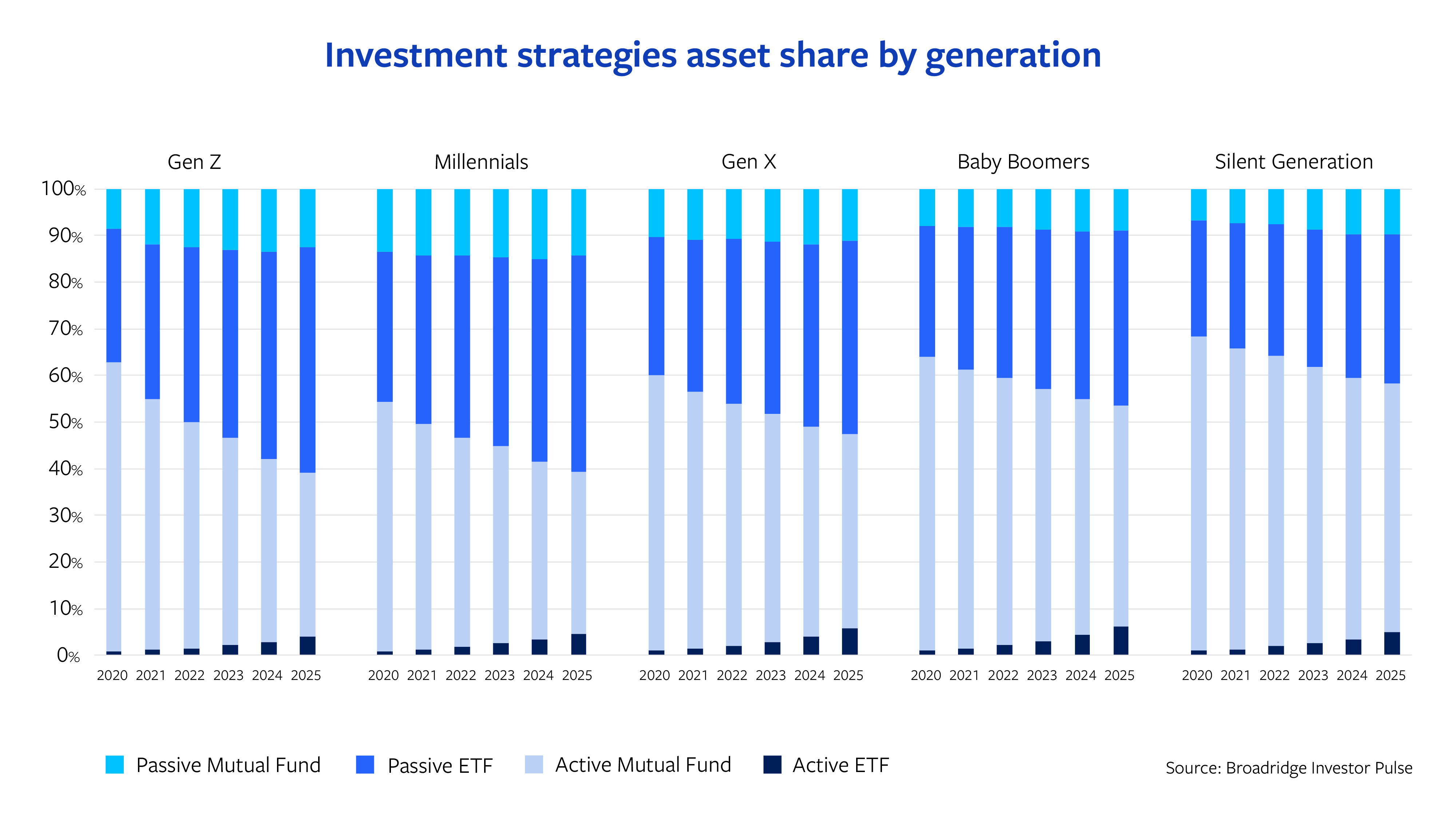
According to the Broadridge Investor Pulse, which analyzes the taxable and IRA accounts of more than 50 million U.S. investors and is the leading source of U.S. retail investment behavior, just 4.6% of Millennial and 3.9% of GenZ investors are currently invested in actively managed ETFs. Although those numbers have grown in recent years, they are still comparable to the active ETF holdings of older generations and have not yet pulled ahead, though time will tell if that trend will change.

Placeholder

Of course, active ETFs and mutual funds are just two types of active investment strategies. The trend toward increased interest in active management has also coincided with an expansion of investor access to new asset classes and solutions including private markets, separately managed accounts, and direct indexing.

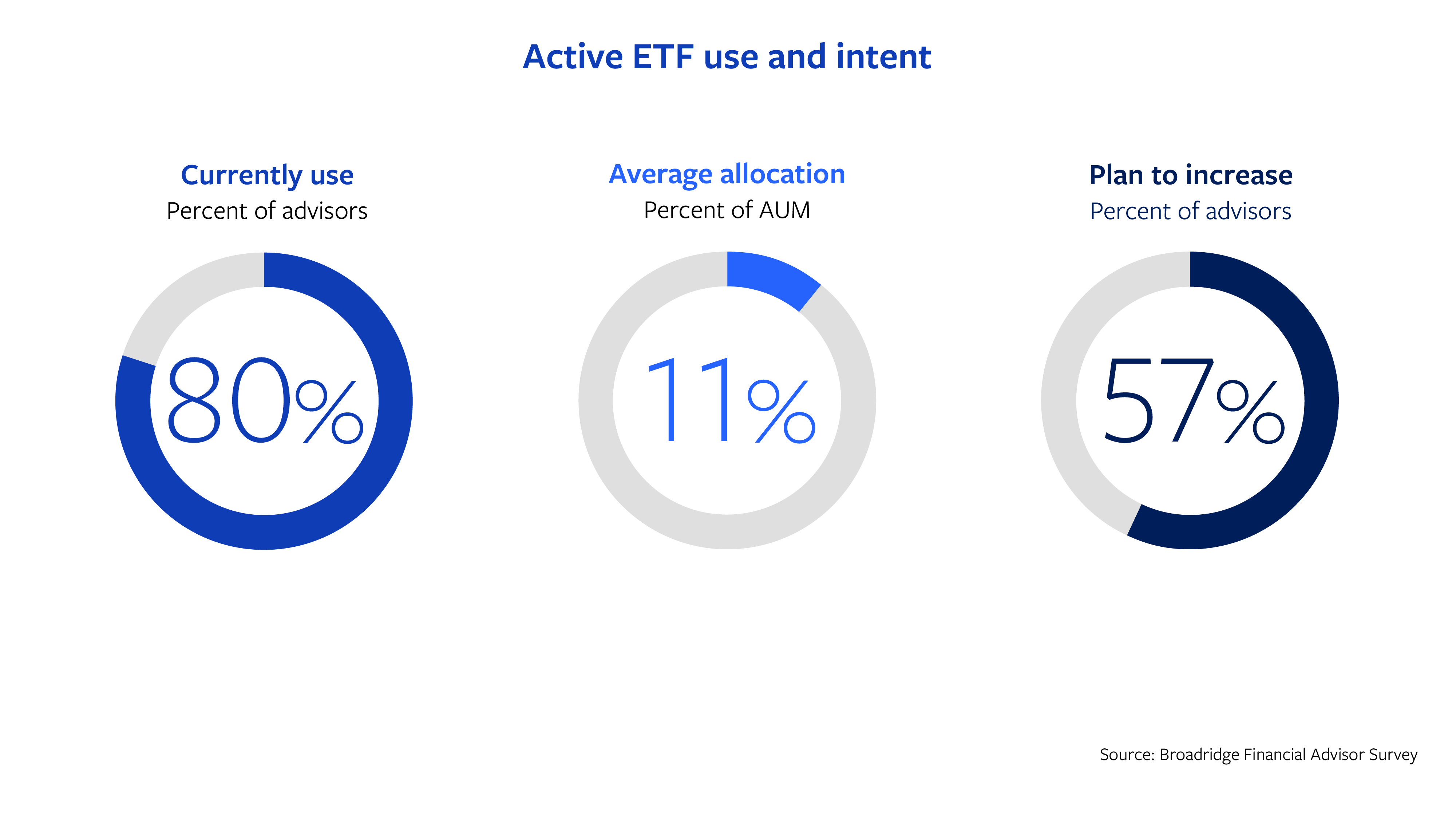
Many advisors have already seized upon these converging trends to start offering a wider variety of investments to their clients. According to Broadridge Financial Advisor Survey, 80% of advisors currently use active ETFs and allocate an average of 11% of their client portfolios to these strategies. More noteworthy, 57% say they play to increase those allocations in the future. Additionally, 82% of advisors say they are likely to use active ETF share classes if they are approved by the U.S. Securities & Exchange Commission (SEC).

Placeholder

Beyond ETFs, 31% of advisors are currently using direct indexing strategies, 46% are investing clients in alternative investments, and 85% are investing in model portfolios.

Active management renaissance?

The shifts occurring in the retail investor landscape are much bigger and far more nuanced than any one metric can capture. Yes, the steady rise in passive ETF volumes has been a dominant trend that cannot be ignored, but, when you peel back the layers of investor behavior, investor interest, and advisor strategy, new trends start to emerge.

The data in this brief points to a scenario in which a confluence of mega trends, including macro market performance, low-fee trading, gamification and the growth of investing apps, and the more widespread accessibility of new investment products have set the stage for a new Renaissance in active management. But don’t expect this active management revolution to look like the last one. New strategies and an empowered new generation of investors are likely to redefine active management and the reshaping of portfolio construction in the months and years to come.

While we are still very much in the early phases of this potential active management Renaissance, the pieces are starting to come into place to support radical changes to the way people think about their investment strategies, and how advisors adjust course to meet those evolving needs. For asset managers, this trend reinforces their core value proposition while unlocking new opportunities for product development and targeted marketing.

Find out more

This Investor Pulse brief is based on data and insights from the Broadridge Investor Pulse, the Broadridge Retail Investor Survey, and the Broadridge Financial Advisor Survey. It was authored by Andrew Guillette, Vice President, Global Insights, Broadridge. Please contact us at the numbers below to connect with Andrew or to learn more about the underlying research.

What's next for your business?

We want to hear more about what you need to improve your business and drive transformative innovation, efficiency, and growth.
required
required
required
required
required
required
required
required
This site is protected by reCAPTCHA and the Google Privacy Policy and Terms of Service apply.
Want to speak with a specialist?
North America
+1 800 353 0103(option 3)
Australia +61 743 569 934
Hong Kong +852 3004 3094
Singapore +65 31 351 278