Hong Kong T+1 Recap: The Readiness Debate
HKEX's proposed move to a T+1 settlement cycle for the cash equities market is part of a broader global shift toward shorter settlement cycles, with North America already on T+1, the UK and Europe preparing for October 2027, and markets such as India and China operating on even shorter timelines.
With HKEX's consultation period closed in May 2026, market reaction has broadly supported the direction of travel while raising questions about market readiness and timing. A Q4 2027 transition would align Hong Kong more closely with global markets, but it would also place the move close to the UK and Europe's T+1 go-live and ahead of some other Asia-Pacific markets.
The key question is how the market can transition safely, with sufficient automation, testing and coordination across the trade lifecycle.
T+1 Is an Operating Model Change, Not a Date Change
T+1 is not simply T+2 with one less day. It compresses the post-trade lifecycle, requiring processes that currently run across trade date and the following day to be completed on trade date or within a much narrower early T+1 window.
Trade capture, allocation, confirmation, SSI enrichment, settlement instruction generation, funding readiness and exception management all need to happen faster, with less tolerance for delay. Ignatius John, Vice President of Product Management for NYFIX Matching at Broadridge, has framed the shift as an opportunity to rethink post-trade operations. "It's not just a regulatory deadline," he said. "It's actually the operating model transformation."
The Cross-Border Challenge Is Uniquely Important for Hong Kong
Hong Kong's market structure makes the transition particularly complex. As a highly international market, it depends on asset managers, brokers, custodians and prime brokers that often operate across different time zones, legal entities and infrastructure platforms.
For US- or Europe-based investors, limited overlap with Hong Kong business hours reduces the time available to resolve allocations, confirmations, funding and exceptions. Domestic buy-side and sell-side firms, custodians and other local participants may be less exposed to the time-zone challenge, but they remain part of a compressed post-trade chain, particularly where they face international clients, counterparties or service providers.
Automation Must Be Treated as Core Infrastructure
HKEX's consultation highlights several timing changes that would move key post-trade processes into a more compressed same-day window.
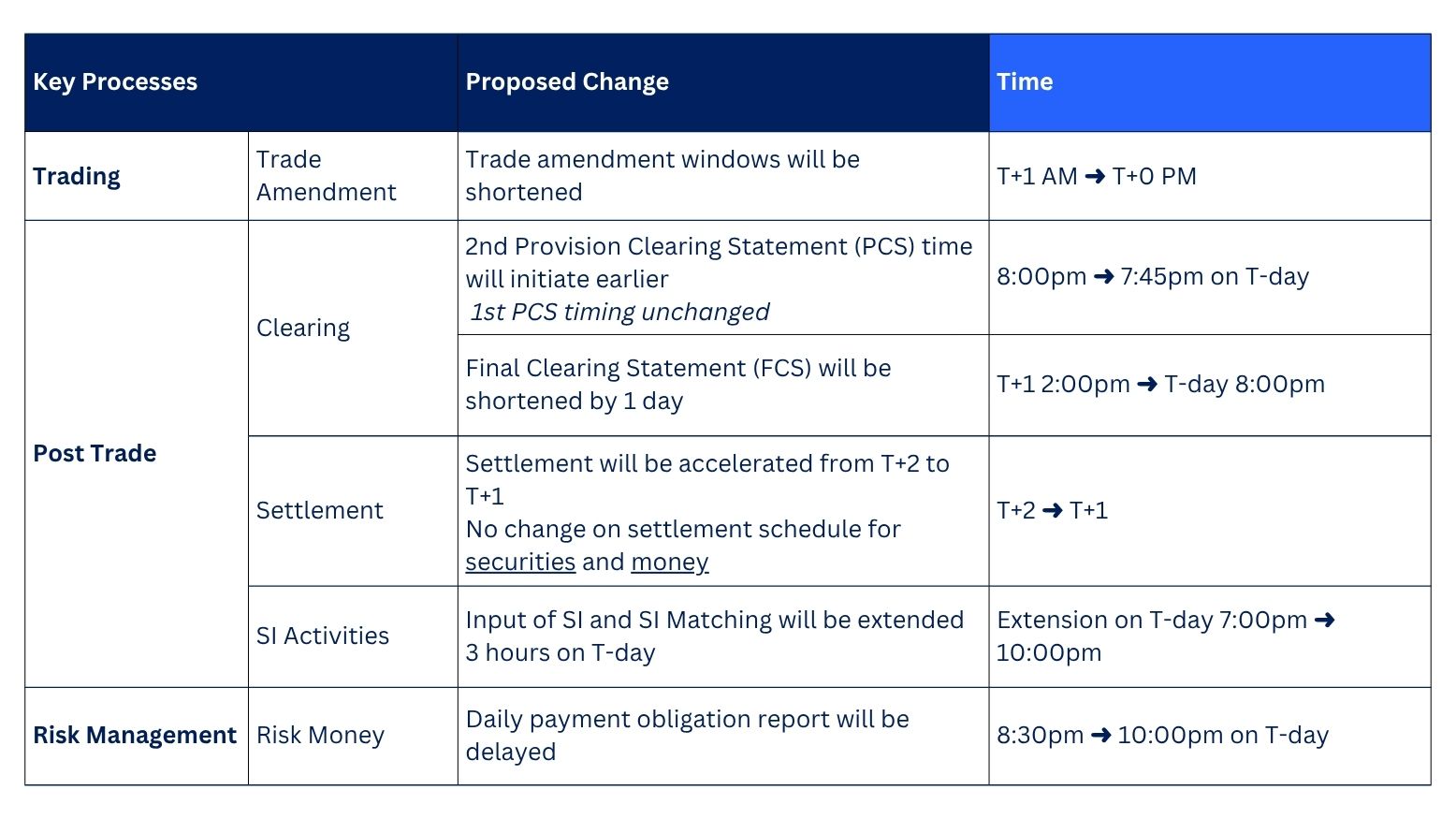
These changes require firms to consume, reconcile and act on market infrastructure outputs much earlier. If late-day processing still depends on manual uploads, downloads or batch handoffs, T+1 could shift risk rather than reduce it. Automated connectivity, real-time processing and intraday exception management will be essential. Enhancements to market infrastructure, such as the Orion Cash Platform initiative, in which HKEX is introducing a real-time REST API to connect with CCASS, replacing the participant gateway, will help brokers and custodians with greater automation. Firms will need to adjust with these changes too.
Allocation and Confirmation Need to Move Closer to Execution
One key lesson from global T+1 moves is that settlement efficiency depends on what happens earlier in the lifecycle. Allocation, confirmation and matching must move closer to execution, supported by standardised workflows, interoperable data and automated communication between counterparties.
HKEX has referenced the potential development of a market-wide workflow tool for institutional participants. Whatever model emerges, the broader requirement is clear: post-trade matching needs to operate closer to execution, with automated onward transmission of settlement instructions to custodians and prime brokers.
The Timeline Needs Careful Sequencing
The proposed Q4 2027 timeline would place Hong Kong's transition close to the UK and European move to T+1, when many global firms will be drawing on the same technology, operations, funding, testing and change-management resources.
James Marsden, Head of Post-Trade for Asia-Pacific at Broadridge, has pointed to the benefits of giving the market additional time after the UK and Europe transition. "We just feel that moving at the same time creates operational risk, and a gap of around three to six months would be more suitable," he said.
The point is not to slow the market's ambition, but to sequence the transition carefully. A successful move to T+1 will depend on industry testing, operational readiness and confidence that the full ecosystem can perform under compressed timelines.
What Firms Should Do Now
Market participants should not wait for final details before beginning readiness work. Firms should review where manual intervention, batch processing, fragmented data or time-zone dependencies could create risk under a compressed timeline.
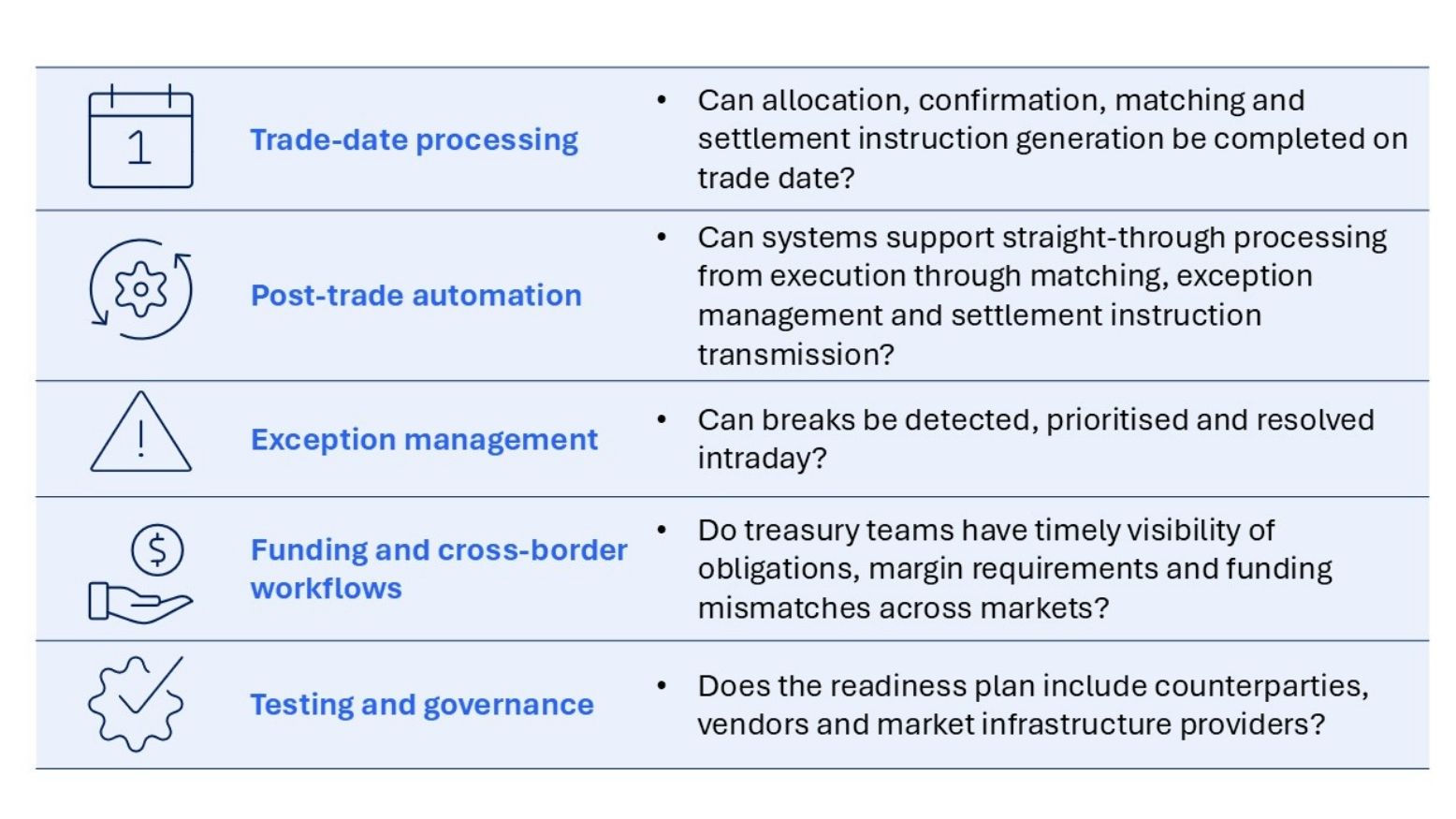
Building for T+1, Preparing for T+0
Hong Kong has an opportunity to advance accelerated settlement in a complex, cross-border market. But the benefits of T+1 will only be realized if the transition is treated as a catalyst for post-trade transformation, not just a deadline.
As James Marsden has noted, firms need sufficient time to test new market infrastructure interfaces and operating processes. And as Ignatius John has cautioned, "You move forward, but cautiously. You just don't jump right into the fire."
Learn more about Broadridge's Post-Trade Processing Solutions and NYFIX Matching.