This article first appeared in Ignites.
Global growth is on the agenda — but operational challenges persist
As asset managers seek growth overseas, they are finding that international expansion requires not just demand but the operational support to scale distribution across jurisdictions.
In recent years, strong domestic inflows, sophisticated capital markets and the dominance of US equities made overseas growth feel optional, perhaps even unnecessary. Now, that narrative is changing.
Many asset managers are looking beyond the US for new distribution and asset growth opportunities amid fee pressure, intense competition and the rise in passive investing. Internationally, there are still areas where demand for the types of actively managed products that US managers can offer remains high.
Future 3Y Organic CAGR, % p.a.
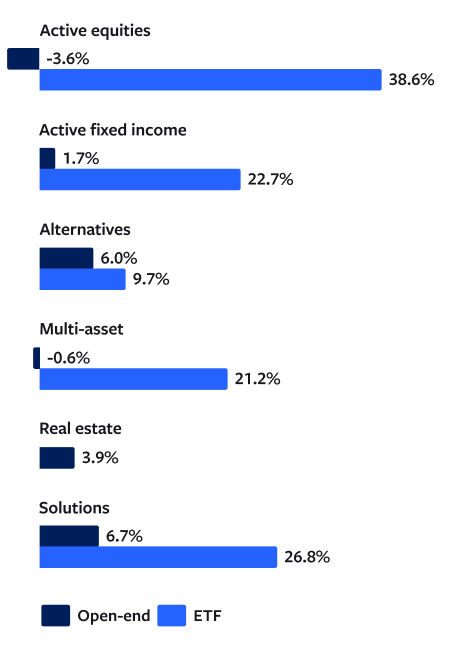
Source: Broadridge Global Demand Model
But scaling across borders cannot be achieved with investment expertise alone. Asset managers looking to expand to Europe and other jurisdictions are experiencing significant obstacles, from unfamiliar regulatory frameworks to fragmented distribution architecture.
This has forced firms to think about global expansion more strategically, using data-driven analysis to identify demand regionally, by investor segment and based on where markets are operationally viable.
"There's demand internationally for certain US investment capabilities," said Marlon Valle, who leads product management and analytics at Broadridge. "The question is whether firms are operationally prepared to support that demand and whether they have the right products and distribution capabilities in place." He added that Broadridge's acquisition of Acolin, a specialist in cross-border fund distribution enablement services, reflects the growing importance of helping asset managers navigate international distribution more effectively.
Operational Pain Points
One of the main hurdles — and surprises — for firms expanding overseas is operational complexity. For example, on the surface, Europe can seem deceptively unified to US asset managers, given the region's standardized UCITS passporting frameworks. However, in practice, cross-border distribution can be highly fragmented, challenging operations teams.
The abundance of local regulators, languages and market practices across multiple jurisdictions can create significant operational friction for firms that are looking to scale internationally.
Because Europe doesn't behave as a single fund market, distribution can present unexpected challenges. For example, if your product data is not distributed correctly in certain markets, investors may never even see the product.
One of the main operational pain points for firms is differing regulatory requirements in each jurisdiction. Inconsistencies in distribution infrastructure across Europe can compound this challenge.
Asset managers are also facing stricter requirements around distributor oversight and ongoing monitoring of how products are sold across different markets. For example, regulations such as MiFID II have tightened expectations around distributor monitoring, target-market assessments and investor suitability, adding to the operational complexity of product distribution across Europe.
As a result, many firms are turning to specialist distribution and infrastructure partners who can address their specific pain points and manage evolving regulatory, reporting and oversight requirements. Many asset managers want to maximize investment performance and build client relationships, while tasks that are operationally complex are increasingly outsourced to specialist providers.
Distribution Support
Regulatory requirements are only part of the challenge. For many firms, the deeper challenge emerges after products are launched and assets begin moving through fragmented distribution networks.
In the US, asset managers are accustomed to highly sophisticated sales and distribution data, which enables them to track flows with enhanced granularity, down to the individual advisor or distribution channel. But distribution visibility can become much harder to monitor and analyze once these firms move beyond their domestic markets.
Successful firms will understand the addressable market before they expand by analyzing where demand exists, whether their products fit those markets and whether they can support distribution operationally over the long term.
Asset managers that launch products internationally often struggle to understand where demand is coming from, imperiling their ability to measure success and understand their distribution footprint.
This becomes an even bigger operational headache when assets pass through multiple intermediaries, platforms and custodians. Managers no longer have the essential visibility over the end investor or advisor relationship, which makes it difficult to evaluate which distribution strategies are working and where future investment should be prioritized.
This means the most critical consideration for firms is scalability: which regions, investors and distribution models are most closely aligned with their operational capabilities and product strengths.
Successful firms will understand the addressable market before they expand by analyzing where demand exists, whether their products fit those markets and whether they can support distribution operationally over the long term.
This creates a powerful incentive for firms to integrate market intelligence, operational infrastructure and local distribution expertise into international strategies that can adapt to different regulatory environments, market structures and distribution frameworks.
International demand may open the door, but sustainable cross-border growth depends on whether firms can support local registration, distributor oversight, data transparency and market-specific execution at scale.
What's next for your business?
We want to hear more about what you need to improve your business and drive transformative innovation, efficiency, and growth.
Want to speak with a specialist?
North America
+1 800 353 0103(option 3)
EMEA
+44 162 591 9082
Hong Kong
+852 3004 3094
Singapore
+65 31 351 278