A public company puts a lot of work into its conversations with investors. There are quarterly earnings calls, investor days, roadshows and, of course, the annual shareholder meeting.
Each leaves something valuable behind. An analyst presses management on an investment decision. A shareholder raises a question about executive compensation. Someone returns to a webcast days later to hear an answer again.
Together, these interactions create a rich body of information about what investors understand, where they want more clarity—and which issues keep coming back.
Yet much of that intelligence remains trapped in the systems where it was collected. The next event comes around, and the IR team starts piecing the picture together all over again.
It's just too much work with too little compounding value.
I've spent much of my career thinking about how companies engage with shareholders. And over the last couple of years, one question has really animated our work here at Broadridge: What could investor relations (IR) teams do if they could learn from the full conversation, rather than reconstructing it one event at a time?
We could see the potential to turn all that untapped information into a real strategic advantage. And now, with advances in AI and platform connectivity, we're finding new ways to consolidate the data and put that intelligence to work.
For IR teams, it's an opportunity to be more proactive than ever before and truly lead the conversation. That's the vision behind our latest innovations, and why I'm excited about what's ahead for investor relations.
The value hiding between events
Investor events are usually planned as separate milestones. That makes sense operationally. Each has its own agenda and demands.
But investors don't experience them in such tidy categories. From their perspective, it's one continuing conversation.
Take a question about margins on an earnings call. In isolation, it may sound like a routine question about quarterly performance. But suppose similar concerns surface at an investor day. Later, shareholders ask about the returns from a major investment program.
The pattern starts to tell a different story. Investors may be questioning whether those returns justify the capital committed. What began as a question about quarterly margins may reflect deeper concerns about management's long-term priorities.
For an investor relations officer (IRO), that perspective is crucial. It can change how the next conversation is framed and help management recognize where investors need more evidence or a clearer explanation.
Connecting the conversations
Broadridge has long had a unique vantage point on investor engagement. Through our shareholder communications and proxy business, we've built a vast digital ecosystem connecting public companies with their shareholders. Our technology supports billions of shareholder communications and digital interactions each year, giving us an unmatched view of shareholder engagement and voting activity.
We've built on that foundation over the years. In 2009, we pioneered virtual shareholder meetings (VSMs). And in the 12 months ending June 2026, we hosted a record 2,542 VSMs, including more than 200 for companies holding their first.
The challenge, of course, is connecting all that shareholder intelligence to the conversations happening throughout the rest of the year. And that's exactly what we're working to do with our expanded investor engagement offering.
We're bringing the expertise and technology behind our VSMs to earnings calls, investor days, and other events throughout the year. Through our broader IR platform, we're also connecting the information generated by those interactions with Broadridge's proprietary shareholder and proxy data.
The immediate benefit is simpler event management, with fewer vendors and less coordination. The bigger opportunity is a much richer understanding of the investor relationship, one that brings shareholder intelligence and ongoing engagement into the same picture.
Two use cases: Turning engagement intelligence into action
1. Think about preparing for an earnings call. IR teams already spend considerable time reviewing transcripts and gathering input from across the business. With a connected view of investor engagement, they could see how questions and concerns have evolved over time, helping management determine where to focus its message.
Now imagine an AI assistant that analyzes those conversations to identify patterns in what investors are asking. This changes the dynamic entirely. IR teams can anticipate the questions most likely to come next and prepare to address them on their own terms.
An IRO could bring those insights into discussions with management, helping executives recognize when investor concerns point to issues the company itself needs to grapple with.
The same intelligence will also reshape shareholder communications.
2. Consider the annual proxy statement. By understanding the questions shareholders have raised throughout the year, companies can make more deliberate decisions about how they explain executive compensation or board oversight, building a stronger narrative around their governance priorities.
In both cases, technology helps surface the intelligence. IR and governance professionals bring the judgment needed to turn it into more strategic and effective investor engagement.
Closing the engagement loop
As we've thought about how to bring this vision to life, I've come to see investor engagement as a cycle with four connected activities:
Convene. Bring investors together through earnings calls, investor days and shareholder meetings. Make participation straightforward, whether people join live, ask questions or return later to review the discussion.
Decide. When voting is involved, eligible shareholders should be able to participate and vote within the same connected experience, preserving the integrity of the meeting and its record.
Communicate. Use what you've learned to make outreach more relevant. Understand which issues deserve attention, who needs to hear what and when to engage.
Learn. Every event adds to the picture. Who attended, what they asked and, where appropriate, how they voted can help shape the next engagement.
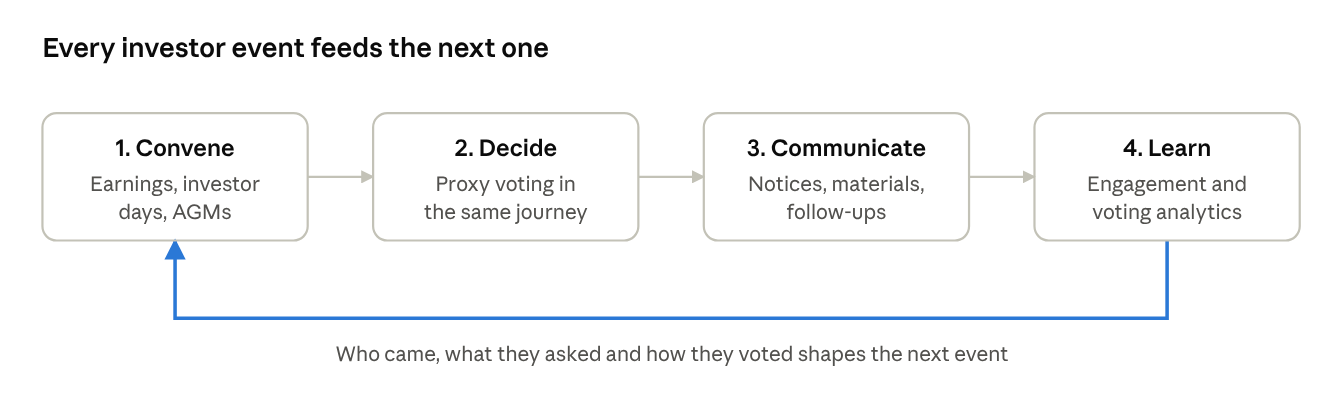
What makes this a continuous cycle is how each event informs the next. Questions raised on an earnings call can influence investor day preparation. Those discussions can inform annual meeting communications. And the annual meeting adds another layer of insight that carries forward.
The upshot? Every investor event feeds the next one.
Making every conversation count
I know how much work goes into making an investor event run well. The details matter. So does the discipline required to communicate clearly when the stakes are high.
None of that changes.
What can change is how much value companies get from the interactions surrounding those events. Helping leadership understand the questions behind the questions is one of the most important things an IRO can do.
And with a clearer view of what investors are thinking, IR teams can shape the conversation with greater confidence and make a more compelling case for the company's strategic direction.
The better we can equip clients to do that, the more meaningful every investor conversation becomes.