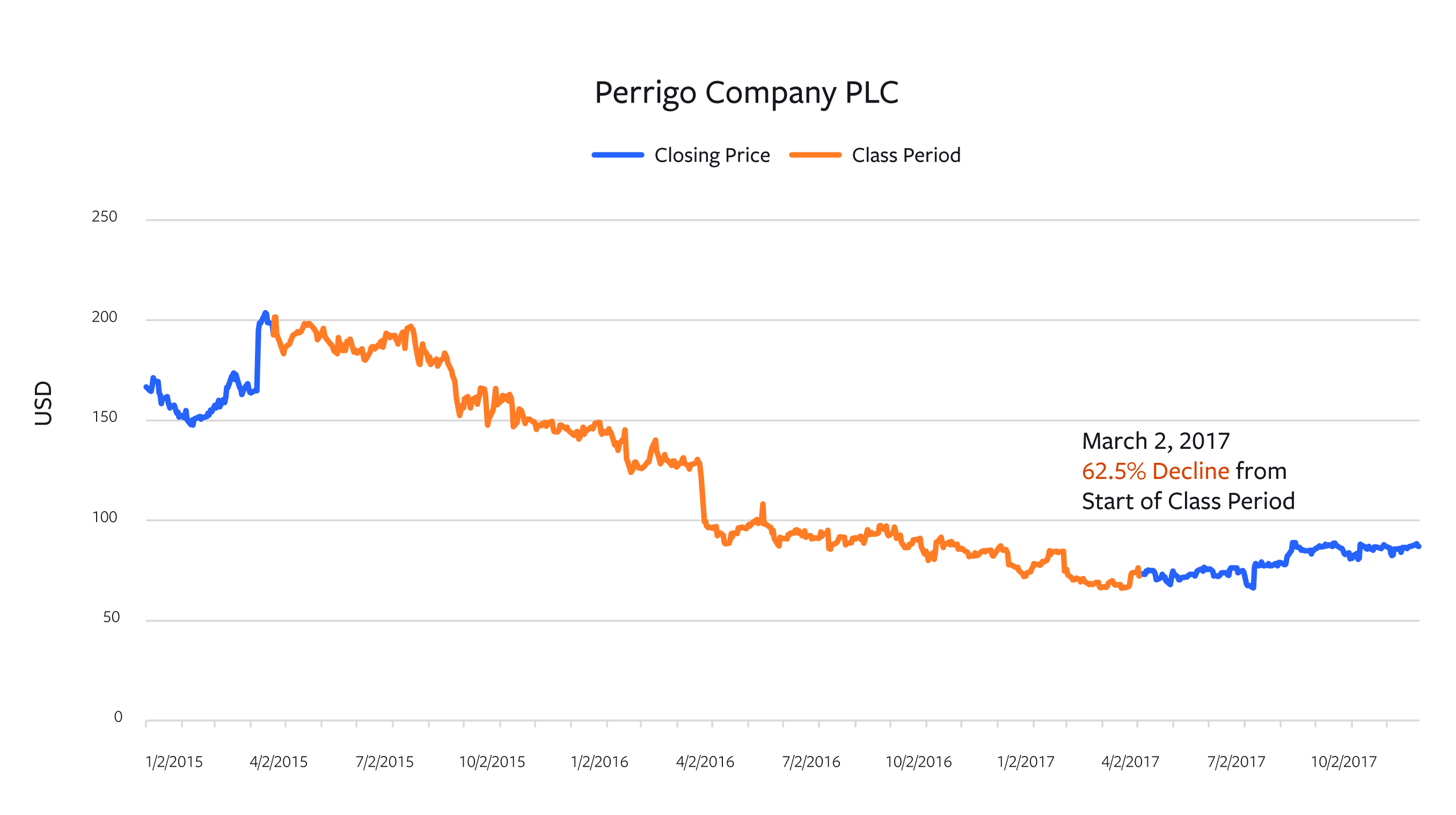
In 2019, the court appointed the lead plaintiff Perrigo Institutional Investor Group1 as class representative, its counsel Pomerantz LLP and Bernstein Litowitz Berger & Grossman LLP as class counsel, and certified the following three classes: (i) all persons who purchased Perrigo’s publicly traded common stock between April 21, 2015, and May 2, 2017, on the New York Stock Exchange (NYSE) or any other trading center within the United States; (ii) all persons who purchased Perrigo’s publicly traded common stock between April 21, 2015, and May 2, 2017, on the Tel Aviv Stock Exchange (TASE); and (iii) all persons who owned Perrigo’s common stock as of November 12, 2015, and who held the same through 8:00 a.m. ET on November 13, 2015, whether or not they tendered their shares in response to Mylan’s tender offer.
The certification of the second group presented an interesting challenge, as in 2010 the United States Supreme Court held in Morrison v. National Australia Bank that United States securities laws do not apply to transactions by non-United States investors who use a foreign stock exchange to purchase shares of a foreign company, commonly known as “F-Cubed” actions.2
As Perrigo is legally headquartered in Ireland,3 and the second certified class is made up of Israeli investors who purchased Perrigo common stock on the TASE, it would appear at first glance that Morrison would bar application of United States securities laws to this subclass. However, because Israel incorporates United States securities requirements and regulations into the Israeli Securities Law, 1968, and because Perrigo was listed on a United States exchange concurrently with its TASE listing, this unique “dual listing” regime allowed the court to certify the class.4 The subclass was subsequently certified on November 14, 2019.
On April 23, 2024, the court preliminarily approved a settlement of $97 million. A fairness hearing is scheduled for September 5, 2024. The claim filing deadline to participate in the settlement is August 26, 2024, and any objections must be submitted by August 6, 2024.
The court’s decision to certify this subclass, combined with the significant settlement reached, underscores the importance of monitoring litigation globally and being ready to act in order to maximize recoveries.5 The Global Securities Class Action Services at Broadridge monitors developments like these, working hard to identify recovery opportunities in every case and for every investor.
Case Challenges
Complicated Loss Formula or Plan of Allocation
The approved Plan of Allocation is complicated, as it requires different damages calculations depending on which subclass Class Members are part of and when they purchased or held their shares. For class members who purchased shares on either the NYSE or the TASE between April 21, 2015, and May 2, 2017, the plan of allocation is divided into four groups, with damages calculated differently depending on the applicable purchase or holding period. Further, two of the groups require that Class Members or administrators determine Recognized Loss using the lesser of the price inflation on the date of acquisition or the “90 Day Lookback Value” of Perrigo common stock. Calculations of this depth increase the time needed for claimants to accurately assess what they are owed. Additionally, they can lead to more incorrect calculations, which in turn can cause claims to be rejected. These complex calculations also make it harder to accurately review and challenge administrators’ determinations.
International Exchange(s)
The dual listing of Perrigo common stock on both the NYSE and the TASE requires class members to take a closer look at their transactions to confirm on which exchange they held the security. It also creates an additional challenge because securities on the NYSE are listed in United States dollars, while securities on the TASE are listed in New Israeli shekels, adding another layer of complexity in calculating recognized losses.
Under Multiple Securities Laws
Although most United States securities class actions seek recovery under either the Securities Act or the Exchange Act, eligibility for this settlement also includes claims based on Israeli Securities Law for transactions in Perrigo common stock on the TASE. This effectively increases the work required, as claims must be prepared and calculated with precision under distinct legal frameworks to maximize potential recovery. A more significant impact is often seen during the claims filing process, particularly when responding to deficiencies identified by the administrator. To ensure the highest possible recovery, it is imperative to engage in meticulous monitoring, comprehensive claim preparation, and efficient data management.
Not Simply a Purchaser Class
Class members who did not purchase any Perrigo shares during the Class Period, but instead held shares from November 12, 2015, through the expiration of Mylan’s tender offer at 8:00 a.m. ET on November 13, 2015, may also be entitled to recovery. This makes the process of monitoring portfolios even more complicated, and extra attention must be given when preparing claims to ensure all eligible positions are included, including any transactions that may have occurred well before the class period.
Old Class Period
Here, the class period began as far back as April 2015, meaning some claims may involve transactions more than nine years old. Because many financial institutions typically retain records for only seven years, some class members may find it difficult to provide transaction details and supporting documentation. Consequently, class members may overlook eligible transactions, potentially affecting their ability to claim recognized losses. Nevertheless, proactive preparation and the implementation of a robust data management solution can help address this issue.
Each year billions of dollars are being left on the table.
1 The group is comprised of Migdal Insurance Company Ltd, Migdal Makefet Pension and Provident Funds Ltd., Clal Insurance Company Ltd., Clal Pension and Provident Ltd., Atudot Pension Fund for Employees and Independent Workers Ltd., and Meitav DS Provident Funds and Pension Ltd.
2 Morrison v. Nat’l Austl. Bank Ltd., 561 U.S. 247, 269 (2010) (theorizing that if Congress intended section 10(b) to apply to “F-Cubed” classes, the statute would have included what to do when there are conflicting laws, as the probability of such incompatibility was obvious).
3 Though as plaintiffs argue, Perrigo has significant ties to the U.S., including that the company was founded in Allegan, Michigan and only later redomiciled to Dublin, Ireland.
4 In a letter written by the Israel Securities Authority (ISA) to the SEC in 2011, the ISA supported the idea that the Supreme Court’s reasoning in Morrison is flimsy when applied to cases regarding TASE investors. The ISA argued that because Morrison’s reasoning is heavily reliant on the conflict of law between United States and foreign jurisdictions, as Israel directly incorporates United States law, the holding should not prohibit Israeli holders of dual listed securities from being included in United States class actions. Additionally, the Israeli Supreme Court in Damti v. Mannkind Corp. has affirmed that United States law applies both to Israeli reporting duties and liability. Civil Appeal Petition 17/8737 Damti v. Mannkind Corporation (16 Oct. 2018).
5 In fact, several courts have reached similar conclusions regarding the exercise of supplemental jurisdiction for foreign TASE transactions. In In re Teva Sec. Litig. the District Court of Connecticut held that supplemental jurisdiction was allowable for Israeli plaintiffs as even the Israeli Supreme Court held the Securities Exchange Act of 1934 establishes liability under the Israel Securities Law, 1968. In re Teva Sec. Litig., 512 F. Supp. 3d 321 (D. Conn. 2021) (citing Roofers’ Pension Fund v. Papa, No. 16-2805, 2018 U.S. Dist. LEXIS 125885 (D.N.J. July 27, 2018). In Costas v. Ormat Techs., Inc. the District Court of Nevada held that it was permissible to apply United States securities law to dual listed Israeli securities as both United States courts and Israeli courts supported this proposition. Costas v. Ormat Techs. Inc., No. 3:18-CV-00271-RCJ-CLB, 2019 U.S. Dist. LEXIS 211349 (D. Nev. Dec. 6, 2019).