The Brambles matter: key facts
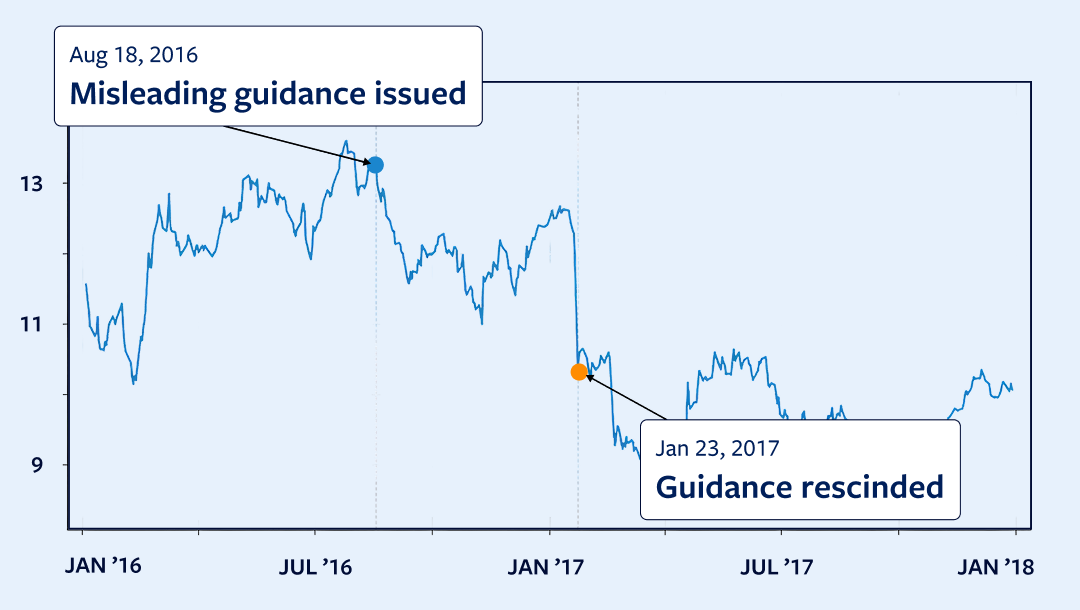
Brambles Limited (“Brambles”) (ASX: BXB) is a global supply-chain logistics company best known for its pallet pooling operations. On August 18, 2016, Brambles issued guidance forecasting FY17 sales growth of 7% to 9% and profit growth of 9% to 11%.[i]The company subsequently reaffirmed that guidance in October and November 2016.
On January 23, 2017, Brambles announced that it no longer expected to meet its earlier guidance. [ii] The announcement was followed by a significant decline in the company’s share price.
Brambles Limited (BXB) closing price
January 1, 2016 - December 31, 2017
Maurice Blackburn commenced a shareholder class action in the Federal Court of Australia, alleging that Brambles made misleading statements concerning its earnings and profit growth expectations and breached its continuous disclosure obligations.[iii] The action was later consolidated with a proceeding filed by Slater and Gordon. Following Echo Law’s replacement of Slater and Gordon, Maurice Blackburn and Echo Law now jointly conduct the consolidated proceeding.
The registration and class-closure process
On August 6, 2021, the Court approved an opt-out notice giving group members until October 14, 2021, to exclude themselves from the proceeding. The notice also provided an opportunity for group members to register their claims.
Shortly before trial, the Court approved a further notice requiring group members to register by July 26, 2022, to participate in any settlement reached before 14 days after the conclusion of trial.[iv]
This was a settlement-specific, or “soft,” class closure. Unregistered group members would have been excluded from a settlement reached during the specified period, but their underlying claims were not permanently extinguished. Because no settlement was reached within that period, the soft class closure expired, and previously unregistered group members may now register their claims.
The proceeding went to a five-week trial between August and September 2022, with closing submissions delivered in October 2022.
A Landmark Decision for Australian Shareholders
On April 10, 2026, the Federal Court issued its decision in Southernwood v. Brambles Limited, finding that Brambles had engaged in misleading conduct and breached its continuous disclosure obligations.[v]
The Court found that Brambles no longer had a reasonable basis for maintaining its FY17 underlying profit guidance from November 16, 2016, and no longer had a reasonable basis for maintaining its FY17 sales guidance from December 21, 2016. Brambles did not withdraw the guidance until January 23, 2017.
The Court further determined that investors who acquired Brambles shares between November 16, 2016, and January 22, 2017, paid an inflated price and may therefore be entitled to compensation.
The decision is significant because it is the first Australian shareholder class action in which plaintiffs succeeded following trial, with the Court making findings supporting both liability and shareholder loss. It also builds on earlier Australian authority recognizing market-based causation by demonstrating how investors may establish compensable loss based on inflation in the market price, without individually proving reliance on the company’s statements.
Brambles announced on July 1, 2026, that it would appeal the judgment. The Court’s findings regarding liability, loss, and the compensable acquisition period therefore remain subject to appellate review.
Broadridge asked Maurice Blackburn, lead counsel in the proceeding, for its perspective on the significance of the decision. The firm described the case as an important reaffirmation of accountability in Australia’s public markets, and was an important win for shareholders and for market integrity. Class actions are a critical enforcement mechanism – they promote transparency, deterrence and confidence in the market, particularly where regulatory action alone is not sufficient to compensate those who have suffered loss. The outcome represents a welcome correction to a run of decisions and settings that have, in recent years, made it harder for shareholders to enforce their rights in relation to market disclosure, and demonstrates that, despite such challenges, shareholder class actions remain a vital means of holding listed companies to account where disclosure failures cause investor harm. It sends a clear message that shareholders, acting collectively, can still achieve meaningful outcomes, even in an environment where the hurdles to bringing these cases have been raised.
What Brambles Reveals about Australian Shareholder Class Actions
Australia has one of the most developed shareholder class action regimes outside the United States, with substantial filing activity and significant settlements. Based on Broadridge data, Australia accounts for half of the largest securities settlements outside North America.
After reforms to continuous disclosure laws during the pandemic period raised the bar for plaintiffs, however, shareholder class action filings dropped sharply; more recent filing patterns suggest a shift in the types of claims being pursued. Of the twenty-seven securities class actions filed between 2021 and 2026, 10 involved earnings guidance, nine concerned business practices, and eight involved alleged financial irregularities. Guidance-related claims increased from just three filings between 2020 and 2022 to eight between 2023 and 2025, suggesting renewed scrutiny of how listed companies formulate, maintain, and revise financial forecasts. [vi] More broadly, Australian class actions are increasingly shaped by overseas litigation, regulatory activity, and funding dynamics.[vii]
The significance of Brambles therefore extends beyond the fact that the matter went to trial. It demonstrates that liability, causation, and loss can be established in an Australian shareholder class action, while also illustrating how registration requirements may affect investors well before a settlement or judgment is reached.
The Lesson for Investors
Group members were asked to register before mediation and trial so they could participate in a potential settlement. Mediation was unsuccessful, the parties proceeded to trial, and the period covered by the soft class closure expired without a settlement.
As a result, group members who did not participate in the earlier registration process may now register their claims. Any recovery remains subject to the pending appeal and the further administration of the proceedings.
The broader class consists of investors who acquired an interest in fully paid Brambles shares between August 18, 2016, and February 17, 2017. Under the judgment as it currently stands, however, only investors who acquired shares between November 16, 2016, and January 22, 2017, have been found to have purchased at an inflated price. That position could change through the appellate process.
Brambles also illustrates why investors should not wait until a settlement is announced before evaluating potential claims. In Parkin v. Boral Limited, the Full Federal Court confirmed that group members may be notified that they will need to register to participate in a future settlement.[viii] Although soft class closure does not permanently extinguish unregistered claims when settlement fails, it can prevent an investor from participating in a settlement reached during the closure period.
Key Takeaways
Brambles is a practical reminder that inclusion in an opt-out class action does not eliminate the need for active monitoring. Registration may still determine whether an investor can participate in a particular settlement, making it important to identify relevant holdings and respond to procedural notices well before a settlement is announced.
For investors evaluating potential eligibility in Brambles or other Australian shareholder actions, Broadridge can help identify relevant holdings, monitor procedural developments, and prepare for registration and settlement-participation requirements.
Case challenges
Australian law and claim filing
Participation in Australian shareholder class actions may require action before settlement. In Brambles, the 2022 soft class-closure period expired without a settlement, allowing previously unregistered group members another opportunity to register. Future investors may not receive the same opportunity if a settlement is reached during the applicable closure period. Early review is therefore important to identify registration requirements and preserve potential recovery rights.
Old class period
The relevant trading period dates back nearly a decade, which may make it difficult for investors to retrieve complete transaction records and supporting documentation. The pending appeal may further extend the process. Early data collection can help prevent eligible transactions from being missed or losses from being understated.
International exchange
Brambles’ international investor base may complicate eligibility analysis and documentation. Holdings may be maintained across multiple custodians, accounts, or jurisdictions, while international investors may be unfamiliar with Australian registration and claims procedures. A coordinated review may therefore be necessary.
Widely held security
As a large and widely held ASX-listed company, Brambles may generate substantial transaction volumes for institutional investors. Identifying eligible activity, consolidating records, and conducting quality assurance may require significant operational resources before a registration or claims submission can be completed.