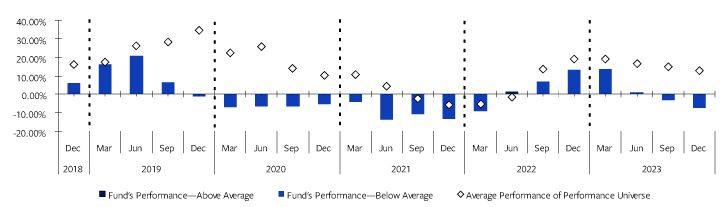
When evaluating a fund's performance, it's not just about comparing its returns to benchmarks or other funds. Whether you're conducting an Assessment of Value (AoV) under the U.K.'s Consumer Duty rules that focus on investor outcomes, or conducting general oversight as described by the European Securities and Markets Authority (ESMA), the analysis goes deeper than looking at returns versus peers and returns versus benchmarks.
Consumer Duty emphasizes whether the fund’s performance aligns with the goals investors have expressed. A fund might outperform its benchmark and be in the top 10% compared to peers, but it could still fall short under Consumer Duty and Assessment of Value if its risk level doesn't align with those stated goals.
A relevant, realistic criteria to review during the AoV process consists of a few elements:
- Comparative performance to the benchmark disclosed in a fund’s prospectus,
- Its relevant Investment Association (IA) sector
- Other funds with the same (or very similar) benchmark
Beyond looking at the net performance of a fund and various comparative performance metrics, the evaluation of risk measures can help you evaluate the value a fund provides to investors. The board can gain an indication of how skilled the portfolio management team is by evaluating the right risk measures, how closely (or not) a fund may be tracking an index, and how much overall risk is being taken to provide investment returns. A fund that exceeds benchmark performance with high relative risk may not, in fact, be providing value to an investor if the fund presents itself as minimizing risk to investors. Understanding the data is important, of equal importance is understanding what the fund says it will do and how it will do it for investors.
What data should we look at?
Although the Financial Conduct Authority (FCA) is clear that net performance must be reviewed as part of the AoV process, it does not provide specifics as to the timeframe needed for that review, or what else that review should entail. Based on Broadridge’s work with U.S. boards for more than 30 years, we believe that displaying multiple time periods for performance is informative. In most cases, we will display one-, three-, five-, and ten-year performance. If a fund has not been around long enough to include for longer time periods, we will include since-inception performance.
With up to four time periods to look at, which is the most important (if that can be determined?). To start the review of performance, we recommend looking at the five-year net return unless there is a specific recommended holding period provided by the fund. This time period allows for the evaluation of a fund’s performance during multiple market cycles, and does not focus on short-term events that may impact a review of one-year returns. Including additional time periods allows for a review of consistency of approach, as well as the ability to review the impact of any changes that have occurred to the management philosophy in the shorter time periods.