
When Gartner® released its 2025 Hype Cycle for Artificial Intelligence in Banking, it appeared to show Generative AI sliding from the “Peak of Inflated Expectations” into the “Trough of Disillusionment.” Many firms are struggling: pilots haven’t scaled, data remains fragmented, governance is ad hoc, and client expectations keep rising faster than delivery can match. While few dispute GenAI’s enormous potential, doubts are growing over whether banks can build the data, governance, and operational frameworks needed to turn early experiments into lasting value.
With 77% of banking CIOs reporting active or planned AI deployments, AI expert Joseph Lo, Head of Enterprise Platforms at Broadridge, gave his perspective on what the AI Hype Cycle means for financial services and how Broadridge’s pragmatic approach, anchored in his “four Ps,” is helping move past the Hype Cycle swings that others are experiencing.
Q: This year’s Hype Cycle reflects a maturing understanding of AI’s potential and limitations. Generative AI (GenAI), while still prominent, is no longer the sole focus. How are you seeing this shift play out in banking?
Joseph Lo: What we have observed is that financial services firms have a big appetite for AI. The promises are compelling: automation, faster service, and solving some of the industry’s lingering inefficiencies. But the reality is that AI on its own is not a silver bullet. Banks are incredibly complex organizations, with siloed systems, regulatory constraints, and heavy reliance on human interaction, and they require a solid framework of governance, integration, and trusted data to unlock the full value of AI.
In the early stages, AI pilots solved limited pain points, which created a sense of inflated expectation: “If it worked here, surely it can work everywhere.” Firms are realizing the real value comes when AI is part of a broader digital transformation strategy. Banks are now shifting from experimentation to execution by strengthening data governance, modernizing platforms, tightening compliance and model risk controls, and focusing on proven use cases, such as fraud prevention, KYC, and customer personalization. Success depends less on novel algorithms and more on building the trusted data foundations, governance structures, and talent needed to scale AI responsibly.
Q: The report appears to offer a strategic roadmap to help banks responsibly scale GenAI by identifying the innovations with the greatest value over the next decade – and Broadridge was recognized as a sample vendor in Banking-Specific GenAI Models. What’s distinctive about your approach?
Joseph Lo: We think about our approach in four dimensions, what I call the four Ps: products, people, policies, and platform.
- Products: We embed AI into our solutions, so data flowing through Broadridge systems is enhanced with AI capabilities delivering predictive insights, faster exception resolution, and more efficient operations.
- People: This one is really at the top of the list for me. We are equipping our 15,000+ associates across 21 countries with AI tools and coaching, reaching an 85% adoption rate. By giving teams more context and skills, they can co-innovate faster with clients, improve productivity, and provide richer support in day-to-day operations. Just as importantly, it helps our leaders and associates see past the hype that often surrounds new technologies, such as inflated promises or unrealistic expectations, and focus instead on practical, proven applications that deliver measurable value.
- Policies: Every use of AI at Broadridge is reviewed by an internal AI governance team. We put a premium on trust, focusing on privacy, intellectual property, information security, and enterprise risk. Our clients are regulated institutions, and they need confidence that uses of AI will always meet the highest standards.
- Platform: Finally, we’ve built a platform-based approach that supports multiple models and central governance. This means as new AI tools emerge, we can adopt them once into the platform, and all our clients benefit immediately. It allows us to respond to new paradigms, new scaffolding, and even new AI interaction patterns. This is critical as state-of-the-art techniques from a year ago are already out of date. Having a vision for 10-year value is good, but I don’t think any of us can imagine what financial services, let alone AI, will look like in 2035.
Together, these four Ps give us a framework that is resilient and adaptable.
Q: Responsible AI is a recurring theme in the Gartner report. How do you embed that into your approach?
Joseph Lo: For us, it comes back to governance and trust. No matter how powerful AI is, no matter how integrated it is, if clients can’t trust it, it’s not valuable.
That’s why we’ve institutionalized responsible AI practices rather than treating them as a checklist required for “go live”. We’ve built them into every part of the lifecycle – from idea generation to how we source and steward data, how we evaluate models for fairness and explainability, and how we monitor them in production. We assess each use case not only for technical fit, but also for human, regulatory, and client impact, and we have instituted technical guardrails to enforce policy.
We also take a pragmatic approach by focusing on applying AI in safe and measurable ways. Each project incorporates incremental improvements in areas like bias detection, auditability, and documentation, so we’re building greater trust with every deployment. That discipline is what pays dividends over time – for clients, regulators, and the industry as a whole.
Q: Many firms are now experiencing the “Trough of Disillusionment” with GenAI. Why hasn’t Broadridge fallen into that trap?
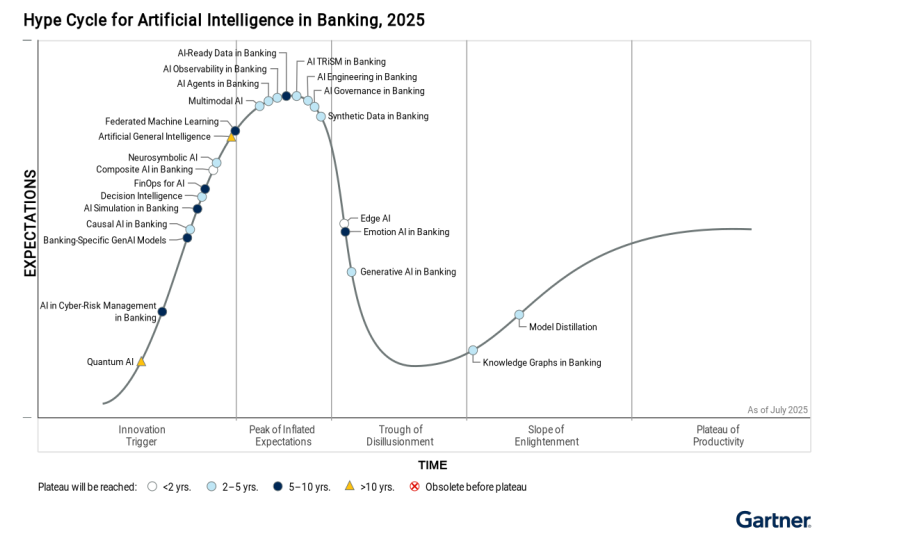
Hype cycle for AI in banking, 2025
Joseph Lo: Many firms rushed into GenAI pilots without the right foundation, and now they are struggling to scale. The key is to treat AI as part of a long-term framework rather than a series of isolated experiments. That means focusing on data, governance, and real use cases that deliver measurable outcomes.
At Broadridge, we are applying AI where it solves our clients’ most pressing challenges. Predictive AI is helping asset managers with global demand modelling, giving traders algorithmic copilots, improving bond similarity and relative value analysis on our LTX platform, and reducing trade fails. In wealth management, it supports early detection of client attrition and next best actions. Our GenAI solutions are powering personalized investor experiences, client chat, and quality control in regulatory communications. And with agentic AI, we are streamlining loan origination, automating reconciliation of trade fails, and accelerating client onboarding through data extraction.
By embedding AI into our solutions and training our associates, we ensure these innovations scale consistently and reliably. The result is a set of AI capabilities that deliver measurable improvements in efficiency, risk reduction, and client experience, and a foundation strong enough to adapt as the technology continues to evolve. Our associates are the inspiration, catalyst, and driver for all our AI innovation. It is hard to be disillusioned when your team has educated, boundless enthusiasm for AI-driven progress and has the numbers to back it up!
Q: Finally, what advice would you give banking leaders navigating this moment?
Joseph Lo: My advice would be to invest in the foundations that make AI sustainable. Equip your people with the right skills, establish strong governance, embed AI into the platforms you already rely on, and ensure your products deliver tangible value to clients. Recognize that value generated in Generative AI is rarely about the AI, but the AI solves for gaps in automation challenges in so many modernization and digitization initiatives. Start small and focus on can-do things before going for moonshots. For banking leaders, this means fewer stalled pilots and more solutions that actually improve efficiency, reduce risk, and enhance the client experience. With the right framework in place, firms can scale AI with confidence and achieve results that last.
Gartner, Hype Cycle for Artificial Intelligence in Banking, 2025, Jasleen Kaur Sindhu, 9 July 2025
GARTNER is a registered trademark and service mark of Gartner, Inc. and/or its affiliates in the U.S. and internationally, and HYPE CYCLE is a registered trademark of Gartner, Inc. and/or its affiliates and are used herein with permission. All rights reserved.
Gartner does not endorse any vendor, product or service depicted in its research publications, and does not advise technology users to select only those vendors with the highest ratings or other designation. Gartner research publications consist of the opinions of Gartner’s research organization and should not be construed as statements of fact. Gartner disclaims all warranties, expressed or implied, with respect to this research, including any warranties of merchantability or fitness for a particular purpose.
This graphic was published by Gartner, Inc. as part of a larger research document and should be evaluated in the context of the entire document. The Gartner document is available upon request from Broadridge.